The Interview Scheduling Gap No One Talks About

Most teams did not feel the scheduling gap all at once. It crept in slowly and quietly, long before it became the obvious breaking point we see today. Over the past year, talent teams were already seeing early signs that something in the hiring process was shifting.
Coordinators talked about losing hours to reminders that never stayed complete and recruiters noticed more calendar changes & more candidate delays where a single conflict caused a chain reaction. Even experienced teams felt like the steps they trusted for years suddenly required twice as much attention.
During this same period, many teams reduced headcount or froze hiring operations staff. The work kept growing anyway. Coordinators felt pressure to move faster while dealing with more interviews, more time zones, and more communication gaps. Managers expected schedules to appear instantly while giving fewer resources and less clarity.
The strain often showed up in small moments. An interviewer forgot to block time. A panel member had a last minute conflict. Each moment felt manageable on its own. Together, they created a growing gap between how people actually work and how the tools were designed to handle that work.
Teams kept moving forward, trying to hold everything together. Many believed these issues were temporary. Some hoped they would ease once market conditions settled. Instead, the pressure continued to build. This demand brings us to the point where the strain becomes impossible to ignore.
This is the moment where the pressure cooker starts to reveal itself.
Summary
The report describes a widening interview scheduling gap driven by rising application volume, shrinking resources, and rigid tools that cannot adapt to real human behavior. In 2025, this pressure exposes three core sub-gaps: 1) candidate friction and ghosting, 2) internal mobility blockers, and 3) recruiter–manager misalignment, while revealing the logic limits of traditional booking tools. The proposed fix pairs a mindset shift toward flexible, personalized processes with intelligent coordination: automated scheduling, a centralized candidate portal, pulse feedback, and real-time coordination dashboards. Done well, teams gain speed and clarity, reduce ghosting, elevate recruiters into strategic advisors, and turn scheduling into a competitive advantage.
The Pressure Cooker of 2025
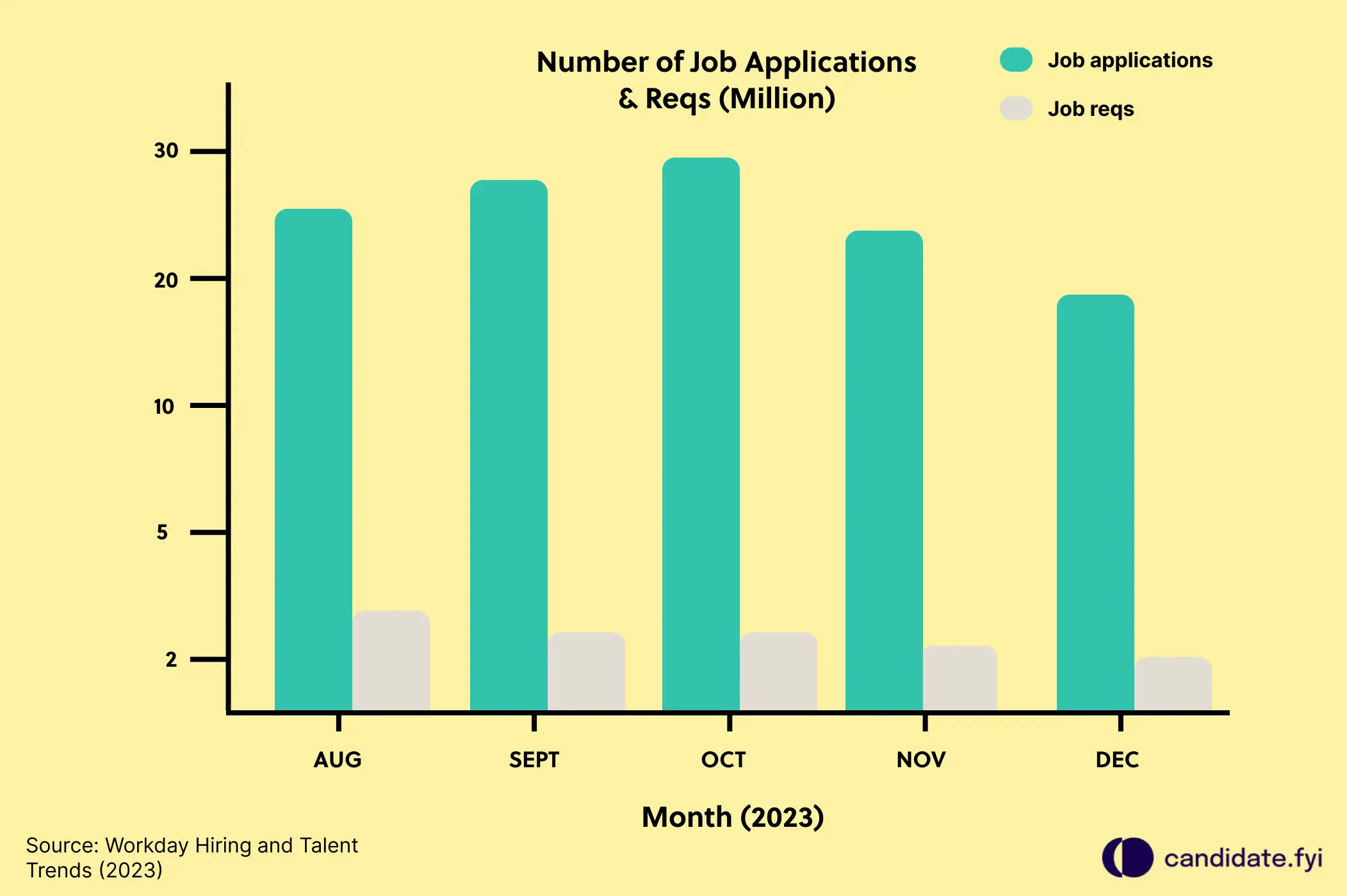
Workday reports a global 32 percent increase in job applications , while open roles have dropped by 13 percent. A smaller number of roles is attracting a much larger number of applicants. This paradox means recruiters are reviewing more resumes, coordinating more assessments, and preparing more interview loops than before, even though their hiring needs have not grown.
Joel Lalgee describes the impact clearly:
"These days, it could be 200, 300, 400 people applying to a job, and you are trying to get to who that top person is. Not in your opinion. Not in the candidate's opinion. In the hiring manager's opinion."
The Resource Squeeze
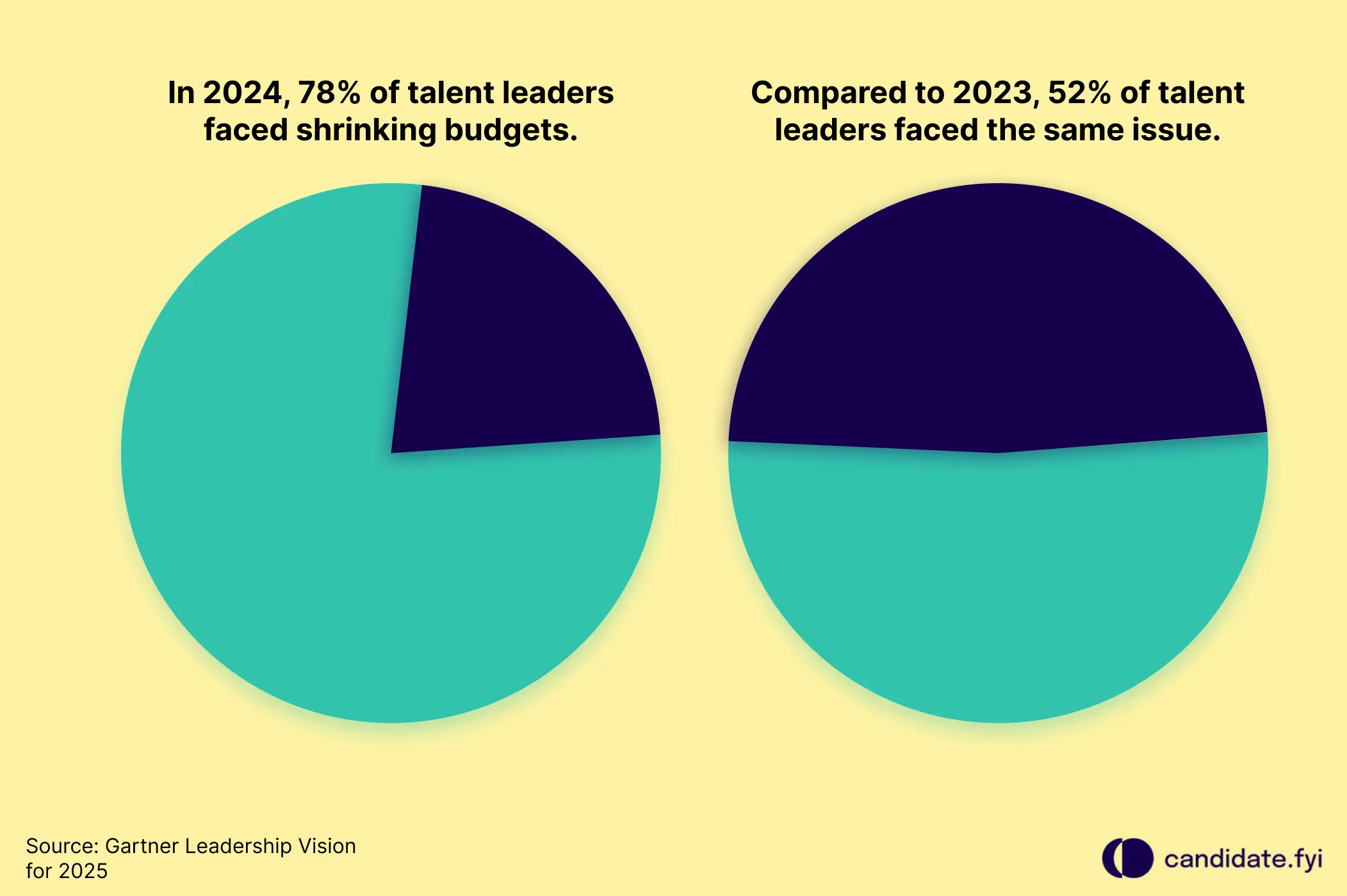
Gartner reports that 78 percent of recruiting leaders face stagnant or shrinking budgets. Many teams operate with fewer resources while the workload increases, directly impacting HR decision-making and strategy.
The shrinking budget creates a gap that cannot be solved with extra effort. When a coordinator is juggling several hundred candidates, hundreds of emails, and dozens of interview loops across teams and time zones, the system breaks.
The Breaking Point
For years, talent teams survived by "brute forcing" the interview schedule. Talent leaders stayed late. They worked in spreadsheets. They checked and rechecked calendars and hoped for a bit of luck.
This approach cannot survive today's volume. The work has outgrown the tools.
Manual scheduling breaks down as the number of candidates rises while the number of people available to run the process stays flat. The pressure in the system has become too high for methods that depend on constant personal effort.
The Core Gap: Structural Rigidity in a Human Process
Teams often think the main issue is a lack of automation. The real problem runs deeper.
Defining the Gap
The gap forms when real human behavior meets rigid systems. Recognizing this disconnect highlights the need for mindset shifts and process redesign to improve scheduling outcomes.
In real life, people change plans. Leaders get pulled into meetings. Candidates answer late. Interviewers forget to block time. These small changes add up until they cause a significant interruption.
In our research, we found three sub-gaps of this ever-expanding gap:
- Candidate Friction and Ghosting Epidemic
- Internal Mobility Blockers
- Alignment Crisis Between Recruiters and Managers
These sub-gaps show the challenge that arises when older rigid systems are faced with changing human behavior.
Jeremy Lyons explains it this way:
"When it comes to scheduling, it is always human. It is the candidate responding late. It is the leader who cannot give you calendar access. It is the person who is a bottleneck for every interview. Systems get us most of the way there. The human part throws a wrench into everything."
The "Human Wrench"
A small change from one person can cause a long delay. A late reply can force a coordinator to rebuild an entire loop.
Traditional tools treat interview scheduling as a simple task. In reality, it is a negotiation. It is a sequence of people with different priorities, habits, and responsiveness levels. The gap grows because our tools do not bend when people move differently than expected.
This human and system mismatch creates friction because the system cannot adapt fast enough when plans change. It is rigid when the process needs to be flexible.
Why Traditional Tools Fail to Close the Gap
The problem is what common interview scheduling software and interview scheduling tools were built to do.
Coordinators spend large parts of their week trying to fit people together like puzzle pieces. Through our customer data and 10 interviews with talent leaders, we found that their recruiting coordinators spend 46% of their hiring time on admin-related tasks, specifically scheduling or fixing interviews Much of this time is spent inside some version of Calendar Tetris.
Tools like Calendly simplify basic booking. They struggle with more complex needs, such as panel construction, interviewer load balancing, training rules, or multi-day loops.
The Logic Deficit
Simple scheduling tools cannot handle exceptions. They cannot judge if the right person is available. They cannot assign a trained reviewer when a conflict appears.
This deficit means that whenever something unexpected happens, the tool stops working and the coordinator must take over manually.
Joel Lalgee put it plainly:
"Sometimes I think we rely on technology too much. The tool gets it wrong and we are not checking the finer details."
This is not a minor issue. It is the main reason why coordinators are still rebuilding schedules by hand every week.
Sub-Gap 1: The Candidate Friction and Ghosting Epidemic
The first clear sign of the core gap appears when real candidate behavior meets rigid systems that cannot adapt quickly enough, creating the friction that leads to ghosting.
The Cost of Friction
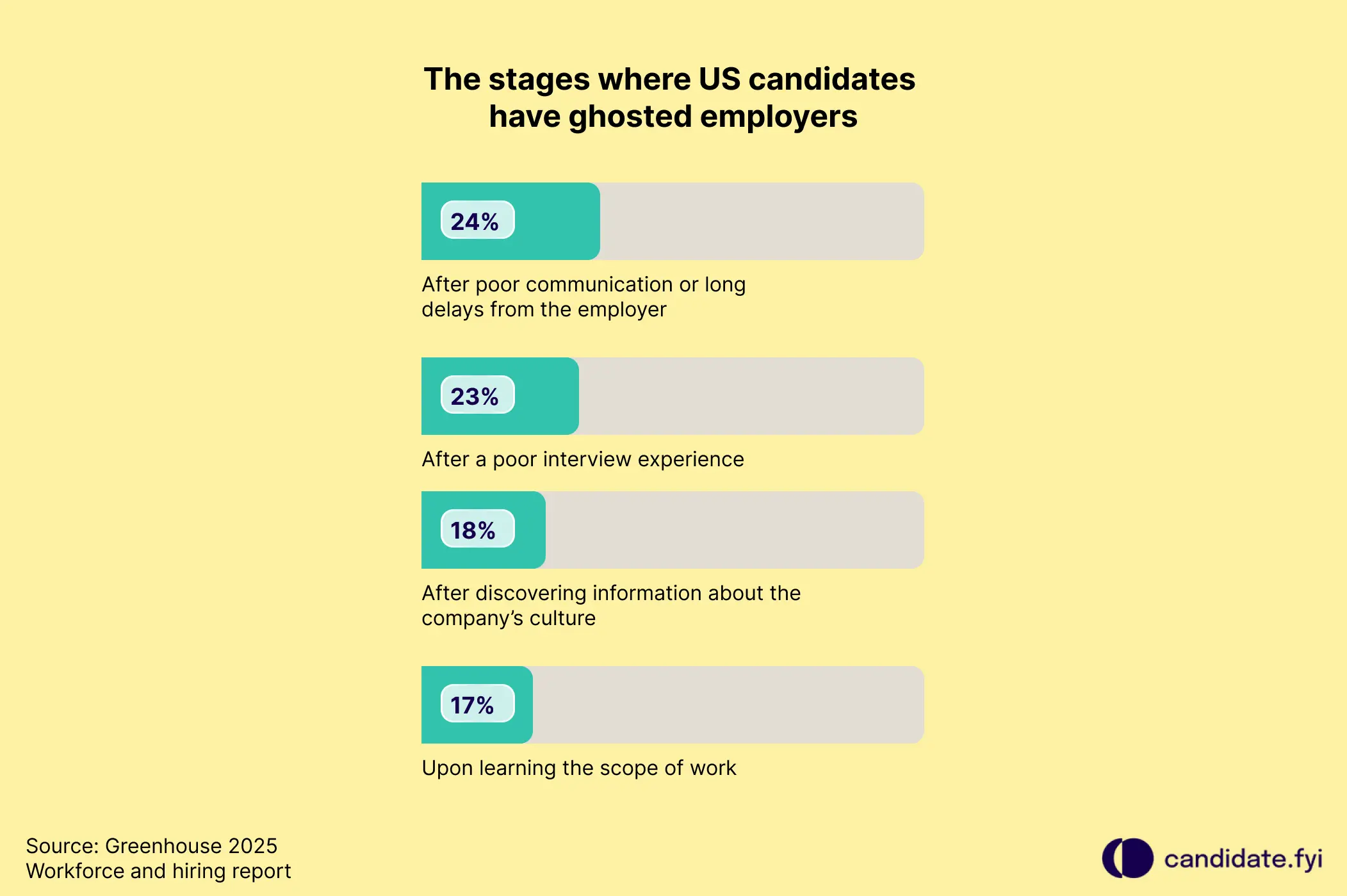
Greenhouse reports that 50 percent of candidates have ghosted employers.
Among those candidates, 24 percent blame slow communication or long delays. This data shows that many drop-offs have nothing to do with the job or the recruiter. The delay itself pushes the candidate away.
Interestingly, most ghosting happens after the interview. Greenhouse found that 63 percent of candidates in the United States were ghosted after a job interview, suggesting that teams lose control of the process just when the candidate is most engaged.
Lost candidates occur when coordinators are buried in scheduling issues. Candidates wait for updates that never arrive, and engagement drops quickly.
To add to the ghosting epidemic, younger talent has even less tolerance for unclear processes.
Greenhouse reported that 73 percent of Gen Z candidates have ghosted employers.
This generation expects clarity and speed. A slow or confusing interview schedule signals that the company is disorganized or does not communicate clearly.
Jeremy Lyons describes the chain reaction:
"If you do not give people context or a clear reason, it spirals. It affects the candidate. It affects the scheduler. It affects the interviewer. One small change can trigger a much bigger problem."
Sub-Gap 2: The Big Stay and Internal Mobility Blockers
The core gap shows up inside the company because internal hiring depends on people moving between teams in flexible ways, while the systems they use remain rigid and slow.
Workday reports that voluntary turnover has dropped. Employees are staying longer. The pressure is now focused on internal movement. Today, 30 percent of roles are filled by internal candidates.
Internal candidates expect better communication and transparency because they already work inside the company.
The issue is that internal scheduling is often more complex than external scheduling. Managers want to review internal talent quietly. Coordinators deal with private calendars, special permissions, and informal expectations around speed.
If internal hiring feels slow or unclear, high performers leave. Workday found that employees who make internal moves see a 26 percent improvement in retention. Internal scheduling is now a retention strategy, not a side task.
Nitin Moorjani shared a memory from his own team:
"A small setting in our permissions opened every user's calendar. It damaged our data. It changed our pass through rate. It looked like a small thing. It had a very large impact."
This is how fragile internal mobility can be.
Diagnose Your Interview Scheduling Pains
Take the 2-minute Recruiting Coordination Maturity Assessment and discover exactly where your team stands and what to fix next.
Sub-Gap 3: The Alignment Crisis Between Recruiters and Managers
The core gap widens further when the people involved in hiring behave in ways the system cannot support, especially when recruiters and managers hold different views on tools, timelines, and expectations.
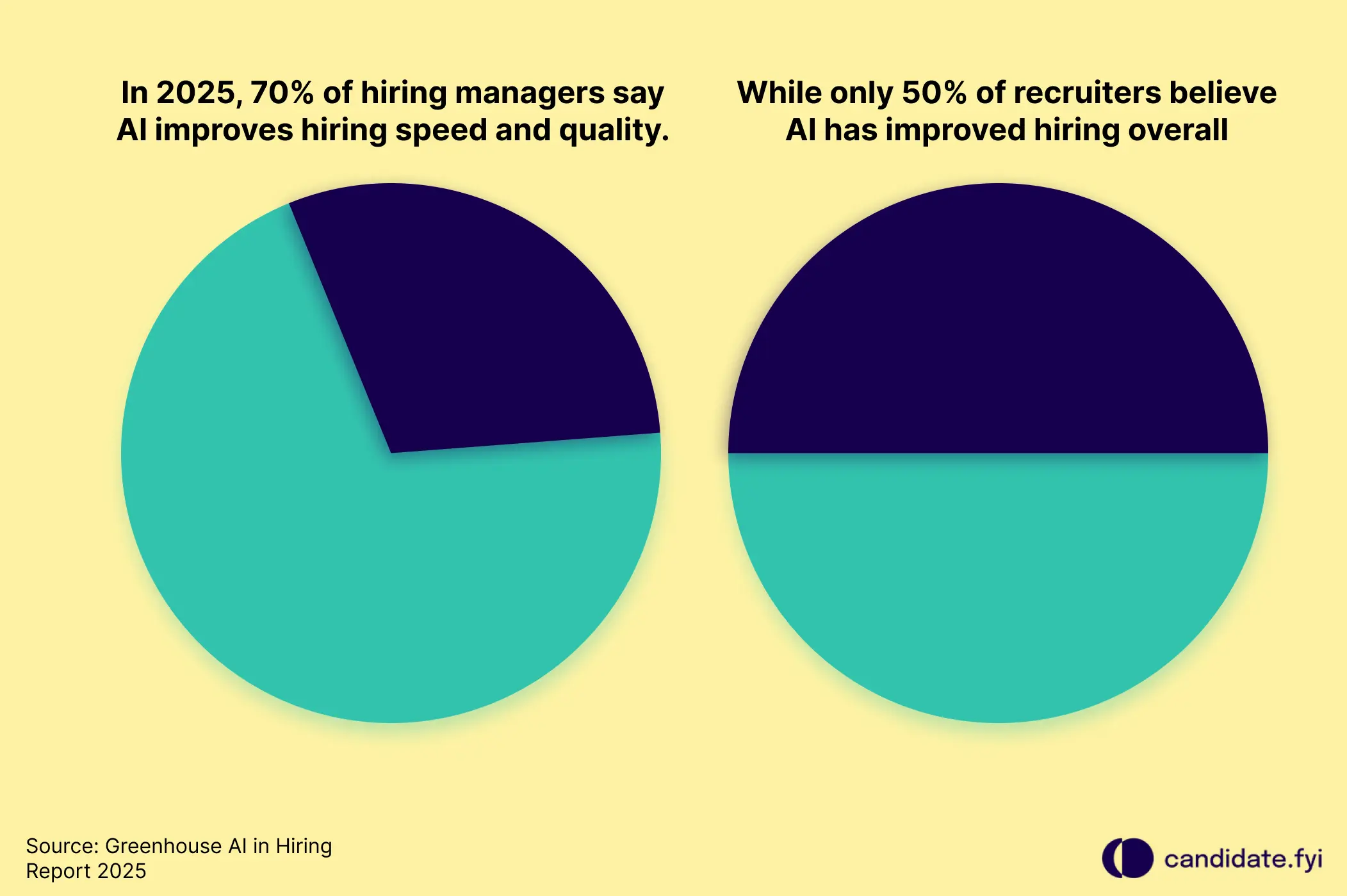
Greenhouse reports that 70 percent of hiring managers believe AI improves hiring speed, while only 50 percent of recruiters agree. This gap leads to misunderstandings around expectations and viewpoints.
Another issue is when hiring managers describe ideal candidates in vague terms. They wait for the perfect profile or ask for more interviews to feel safe making a decision. Coordinators are left trying to organize a process with unclear rules.
Joel Lalgee gives context:
“Many hiring managers fall into a risk mindset. They do not want to make the wrong hire. So they look for people doing the same job at a competitor.”
When expectations are unclear, the interview loop gets longer and more complicated. Every extra step increases the chance of a scheduling breakdown.
The Implications: What This Gap Costs the Enterprise
This gap affects far more than one interview.
Candidates who face long delays or confusing instructions often quietly exit the process. They also tell friends or colleagues. The Greenhouse ghosting statistics show that slow communication is one of the top reasons for withdrawal.
Further, when coordinators spend most of the week rebuilding loops, checking calendars, and writing reminder emails, they cannot act as strategic partners. This strategic deficiency creates burnout because the work feels endless and reactive.
Finally, most teams do not measure the right things. They track time to hire but do not track time lost to rescheduling, interviewer capacity limits, or the real weight of manual back-and-forth. As a result, the root issues stay invisible.
Jeremy Lyons explained it well:
“When people start making changes, they stop asking if they would want to be a candidate in their own process. They assume candidates will do the dance because they want the job. That is not how people behave today.”
The Solution Part 1: Shifting the Mindset
Fixing the scheduling gap starts with changing how teams think about interviews.
First, teams often follow strict steps for every role. This strictness is where rigidity collides with human behavior. The future requires more personalization. Some roles need technical assessments first. Others need manager screens first. Some candidates need slower steps. Others need faster ones.
A flexible interview schedule allows people to move through the process naturally.
Workday reports that modern recruiters must evolve into advisors. They need time to look ahead, guide managers, and shape the process. They cannot do this if they are trapped inside a calendar all day.
Joel Lalgee calls this the next major skill shift:
“Going from order taker to strategic partner is a major challenge. You need to understand the business, the goals, and what the team needs in the next quarter.”
The Solution Part 2: Intelligent Coordination
Once the mindset shifts, teams need technology that supports the new model.
Starting with simple booking links, this tool easily breaks under pressure. The links cannot understand the interviewer training. It cannot distribute the load fairly. It cannot instantly adjust to conflicts.
Teams need tools that handle these details in the background.
Automated Interview Scheduling
Many recruiting coordinators still rely on manual admin work to keep the interview schedule moving.
They confirm times by email, send reminders throughout the day, check availability across several calendars, and much more.
These steps take time because each action depends on waiting for someone to reply. Coordinators often mention that one slow response can hold up an entire loop. In our market research, coordinators called this “living inside the inbox” and “refreshing calendars all day.”
Automated interview scheduling replaces this pattern with a workflow that can detect conflicts, find backup interviewers, and assign people based on capacity and rules.
In practice, this should look like:
- When a leader cancels, the system should find a trained replacement.
- When an interviewer reaches their weekly capacity, the system should shift the load to another interviewer.
- When a candidate needs a different time zone, the platform should adjust without extra effort.
This is the value our fyi AI agent brings. It reduces the amount of manual effort required and allows coordinators to focus on high-value work rather than chasing tasks that pull them in several directions at once.
Nitin Moorjani describes why this matters:
“Reporting in recruiting has always been low level. You cannot see how many interviews you run each week or how much load sits on each coordinator. When you connect scheduling to candidate experience scores, everything becomes clear.”
The Candidate Portal
A large portion of candidate confusion comes from scattered communication. Most teams still depend on emails, fragmented ATS messages, and scattered links to deliver interview details.
Candidates often miss information because messages get buried, filtered, or sent from unfamiliar systems that look like spam. Greenhouse data shows that 24 percent of ghosting candidates cite poor communication as their reason for withdrawing, which reflects how often these cracks appear in the process.
Further, many RCs told us they receive repeat questions from candidates who lost an email or never opened an ATS notification.
A clear, branded candidate portal, like the one candidate.fyi offers, solves many of these communication problems.
It gives candidates one place to check their interview schedule, prep materials, interviewer details, and next steps. It explains the process, which reduces surprise and confusion. It also turns passive communication into a structured experience.
Instead of reacting to gaps, candidates stay informed, and coordinators spend far less time answering one-off questions or resending details that should have been accessible from the start.
Candidate Feedback
Talent teams in 2025 still use traditional candidate feedback surveys that only go out after the candidate receives the final decision. This creates two problems.
First, the feedback window arrives long after the actual experience, which lowers engagement and leads to forgotten details. Second, candidates who receive bad news tend to give emotionally driven responses, which raises the bias of the results.
Across teams we interviewed, completion rates often fall to 20 percent or less. Coordinators told us that by the time they receive feedback, the insights are too late to fix the issues that caused the negative response.
Pulse survey feedback takes a different approach by capturing sentiment immediately after each stage of the process. It collects real reactions while the experience is fresh and surfaces problems before they grow.
Coordinators gain visibility into interviewer performance, clarity of communication, and sudden drops in candidate satisfaction. This allows teams to make adjustments quickly instead of waiting until the end of the process when it is too late to change the outcome.
Coordination Dashboard
Most ATS platforms handle basic tracking, but they do not give recruiting coordinators a clear, real-time view of where each candidate stands.
In our interviews, talent leaders described using spreadsheets, Slack threads, calendars, and personal notes to understand the status of each interview loop. They often had to click through several ATS screens to find out who they were waiting for, whether it was a candidate who had not yet provided availability or a hiring manager who had not submitted feedback.
They also lacked immediate visibility into declines, cancellations, or stalls. This slows the entire pipeline and creates uncertainty for the team.
A scheduling dashboard, like the one candidate.fyi has, changes the experience by showing everything in one place. Coordinators and talent leaders can see every candidate, every stage, and every outstanding action. They can spot bottlenecks early and receive real-time updates when someone declines or reschedules.
Instead of spending hours piecing together information from scattered tools, they can act on accurate, current data.
Proof of Speed
The clearest measure of intelligent coordination is improved velocity. Many teams that rely on manual scheduling describe long back-and-forth cycles that stretch across several days.
Some interview loops take a full week to finalize because each step depends on several people responding on time. When an AI interview scheduling tool handles the logic and communication flow, the pace changes dramatically.
Relativity Space improved scheduling speed by 76% in 6 weeks. They dropped from 2.8 days to 16.2 hours. That improvement came from intelligent coordination inside a complex environment.
Cory O’Brien shared this exciting data:
“In our first month [on candidate.fyi], we averaged 2.8 days to schedule interviews. Now, just halfway through month two, we’ve reduced that to 16.2 hours — a 76% improvement in a very short amount of time.”
Elevating the Recruiter: The Shift to Talent Advisor
Automation does more than remove busywork. It changes the role entirely.
Internal data from candidate.fyi shows that the fyi AI agent handles 46% of scheduling tasks, such as confirming times and sending reminders. Candidates themselves handle 26 percent through self-service. Recruiters handle only 28 percent of the manual workload.
Our internal data shows that almost half the work disappears.

From Admin to Architect
Once repetitive work is automated, recruiters can focus on advising managers, improving processes, and finding stronger talent. This strategic involvement is what modern teams need most.
Nitin Moorjani sees this shift happening now:
“AI and automation teach us to work differently. We need to relearn old tools and use them in more creative and innovative ways.”
Jeremy Lyons expands on this:
“In recruiting operations, we are finally thinking with a product mindset. We define the user, shape the experience, and design the flow. That is what makes us a strategic partner.”
Closing the Interview Scheduling Gap
The data in this report shows a clear pattern. Candidate volume is rising. Resources are shrinking, and the interview schedule is where all of these pressures collide.
Teams cannot solve this with brute force anymore. They need flexible processes and a centralized candidate portal that creates clarity at every step. They also need automation that handles the parts of scheduling that break most often.
Closing the scheduling gap turns the interview process into a competitive advantage. It gives candidates a better experience. It provides managers with faster access to talent. It gives recruiters the space to advise the business rather than fight the calendar.
The era of Calendar Tetris has reached its limit. The future belongs to intelligent orchestration and a hiring process designed for real people.
Methodology
This report is based on a combination of internal customer data, external market research, and qualitative interviews conducted with talent teams throughout 2024 and 2025.
Our internal dataset includes more than 12,000 interview scheduling actions performed across enterprise organizations using candidate.fyi since launch last year. These actions span confirmations, reminders, conflict checks, interviewer replacements, time zone adjustments, and ATS updates.
To ground this internal data in a broader industry context, we analyzed third-party research from Workday, Greenhouse, and Gartner. We also interviewed recruiting coordinators, hiring managers, recruiting operations leaders, and industry experts to understand how scheduling challenges appear inside real teams.
These conversations included customers such as Amperity, Relativity Space, and Yext, whose perspectives helped clarify the growing mismatch between modern hiring demands and legacy scheduling tools.
Together, these sources provide a clear picture of how interview scheduling functions today and what forces are shaping the next phase of hiring operations.
Q&A
Question: What is the "interview scheduling gap," and why is it showing up so strongly now?
Short answer: It's the growing mismatch between how people actually behave and how rigid scheduling systems expect them to behave. Over the past year, reduced operations headcount, more interviews across time zones, and higher expectations from managers compounded small issues like last‑minute conflicts and forgotten calendar blocks. In 2025, the pressure spiked: Workday reports a 32% increase in applications while open roles dropped 13%, so coordinators are managing more activity with fewer resources. The old "brute force" approach---late nights, spreadsheets, constant rechecks---no longer scales, and the gap has become impossible to ignore.
Question: Why aren't traditional scheduling tools enough for today's interview volume and complexity?
Short answer: They were built for simple booking, not negotiation-heavy orchestration. Tools like basic booking links struggle with panel construction, interviewer training rules, load balancing, and multi‑day loops. When plans change, these tools can't apply the right logic or substitutions, so coordinators jump back in to rebuild schedules. Gartner notes recruiters spend 66% of hiring time on interview-related tasks, much of it "Calendar Tetris." The result is a persistent logic deficit: exceptions break the system, and manual work fills the gap.
Question: What are the three sub-gaps driving interview scheduling breakdowns, and what do they look like in practice?
Short answer:
- Candidate friction and ghosting: Greenhouse reports 50% of candidates have ghosted employers, with 24% citing slow communication; 63% were ghosted after interviews, and 73% of Gen Z have ghosted. Delays and scattered messaging push candidates away just when engagement should peak.
- Internal mobility blockers: With 30% of roles filled internally and voluntary turnover down, internal movement matters more---but it's complex (private calendars, permissions, confidentiality). Workday shows internal moves boost retention by 26%, yet small system misconfigurations can derail outcomes.
- Alignment crisis between recruiters and managers: Greenhouse finds 70% of hiring managers believe AI speeds hiring, versus 50% of recruiters. Vague requirements and a risk‑averse "one more interview" mindset elongate loops and raise the chance of scheduling failure.
Question: What does "intelligent coordination" look like for recruiting coordinators, and what outcomes can teams expect?
Short answer: It combines automated interview scheduling (conflict detection, trained replacements, capacity balancing, time zone handling) with a candidate portal (centralized schedules, prep, interviewer info, next steps), pulse surveys (stage-by-stage feedback while experiences are fresh), and a coordination dashboard (real‑time loop status and bottlenecks). The impact is measurable: Relativity Space cut time‑to‑schedule by 76%, from 2.8 days to 16.2 hours. Internal data from candidate.fyi shows its AI agent handles 46% of scheduling tasks, candidates self‑serve 26%, and recruiters only manage 28%---freeing teams to focus on higher‑value work.
Question: How does this shift elevate recruiters, and what should teams measure to actually close the gap?
Short answer: Automation moves recruiters from "order takers" to strategic advisors---designing flexible processes, guiding managers, and improving quality rather than fighting calendars. To sustain improvement, track what's been invisible: time lost to rescheduling, interviewer capacity and load, response lag at each step, the share of tasks handled by automation vs. humans, candidate communication gaps (e.g., portal usage), and feedback completion via pulse surveys. The report notes most teams fixate on time‑to‑hire while missing these drivers; making them visible turns scheduling into a competitive advantage.
Question: How can teams materially reduce candidate ghosting?
Short answer: Eliminate friction and delays with clearer, faster communication. Greenhouse reports 50% of candidates have ghosted; 24% cite slow communication, and 63% were ghosted after interviews---exactly when interest should be highest. Consolidate instructions and updates in a candidate portal (not scattered emails), speed up loop assembly with automated scheduling, and capture stage-by-stage pulse feedback to catch issues while they're fixable. This clarity and velocity particularly matter for Gen Z, 73% of whom have ghosted employers.
More Articles
7 AI Interview Scheduling Tools for Lean Recruiting Teams
A ranked comparison of seven AI interview scheduling tools for lean recruiting teams without dedicated coordinators. Covers candidate.fyi, GoodTime, Paradox, ModernLoop, Rooster Scheduling, Calendly, and Lunacal -- with first-party data on scheduling speed, coordinator capacity, and ATS integration.
What Does a Recruiting Coordinator Do?
A recruiting coordinator owns the logistics of hiring: interview scheduling, candidate communication, and interviewer coordination. This guide breaks down what a recruiting coordinator does day to day, how the role differs from a recruiter, and why it sets your team's hiring speed.

candidate.fyi vs Calendly for Recruiting Teams
Calendly matches calendars. Automated interview scheduling has to build panels, sync with your ATS, and manage candidate communication. See where Calendly breaks down for recruiting teams and what candidate.fyi does differently.