2026 Recruiting Coordination Statistics: From Problem to Solution


The article below is an excerpt from our Interview Scheduling Gap Report and Recruiting Coordination Wrapped Report. Both reports are entirely free at the included links.
The recruiting coordination function has been under quiet strain for years. While enterprise hiring teams focused on sourcing technology, employer branding, and ATS optimization, the coordination layer remained largely unchanged, relying on the same manual processes that have existed for decades.
That gap finally became impossible to ignore in 2025.
This post synthesizes data from two comprehensive reports we published over the past two months: the Interview Scheduling Gap Report and the Recruiting Coordination Wrapped 2025. Together, they paint a complete picture of the recruiting coordination crisis and the path forward.
The data below comes from analysis of 257,946 coordination signals, 12,000+ interview scheduling actions, and interviews with recruiting coordinators, operations leaders, and industry experts across enterprise talent teams.
Summary
The recruiting coordination function faces a structural crisis driven by three converging forces: application volume up 32 percent, recruiting budgets flat or shrinking for 78 percent of teams, and coordination tools that cannot adapt to real human behavior. Our research shows that recruiting coordinators spend 46 percent of their time on admin-related scheduling tasks, while candidates ghost employers 50 percent of the time due to slow communication. However, teams using automated interview scheduling achieve dramatically different outcomes: coordinators handle 158 interviews per week compared to roughly 30 manually, time to schedule drops from 243 minutes to 27 minutes with self-scheduling, and interviewer decline times shrink from 68 hours to 21 hours with AI assistance. The data reveals that coordination capacity is no longer a headcount problem but a systems problem, and the teams solving it are transforming recruiting coordinators from invisible executors into strategic talent advisors.
The Coordination Crisis: Key Statistics on the Problem
Application Volume vs. Resources
The pressure on recruiting coordinators begins with a fundamental mismatch between workload and capacity.
32% – Global increase in job applications (Workday)
13% – Drop in open roles
78% – Percentage of recruiting leaders facing stagnant or shrinking budgets (Gartner)
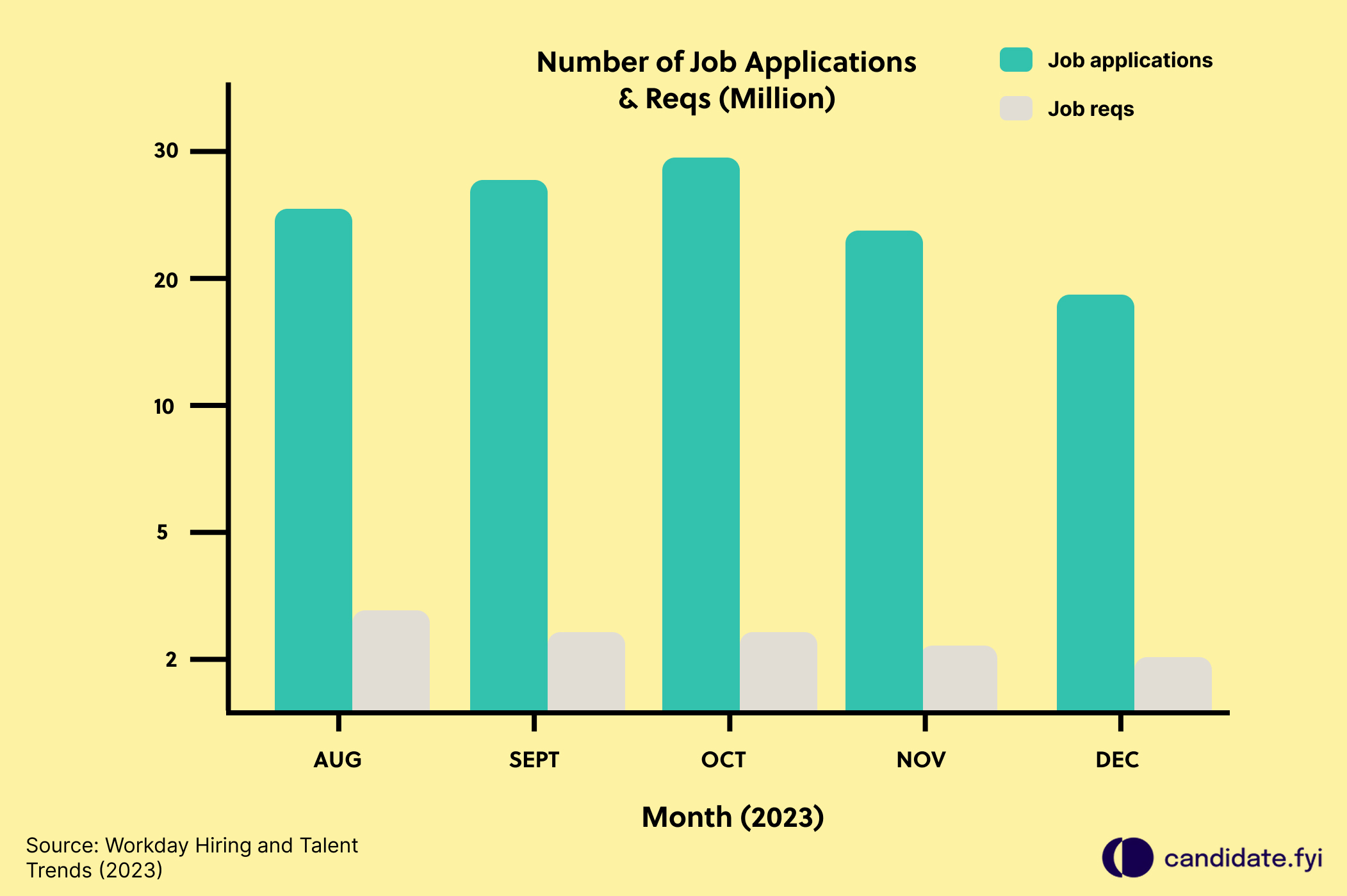
These numbers create a compression effect. Fewer roles are attracting more candidates, which means more screening, more assessments, and more interview loops to coordinate. At the same time, talent teams are operating with the same headcount or fewer resources than before.
The math does not work. When application volume rises by a third while budgets stay flat, something has to break. That breaking point typically shows up in the coordination layer.
The Hidden Cost: Time Spent on Scheduling
Coordination work is often invisible until it becomes a bottleneck. Our research quantifies exactly how much time recruiting coordinators lose to repetitive admin tasks.
46% – Percentage of coordinator time spent on admin-related scheduling tasks
243 minutes – Average time to schedule an interview manually (via availability requests)
These numbers expose the "scheduling tax" that slows down every hiring process. Nearly half of a coordinator's day disappears into chasing availability, sending confirmations, managing reschedules, and rebuilding calendars when conflicts appear.
The 243-minute average is not three hours of focused work. It is three hours of cumulative back-and-forth, context switching, and waiting for humans to respond. When this delay repeats across dozens of candidates each week, the system grinds to a halt.
Joel Lalgee, a recruiting operations expert, described the dynamic clearly:
When it comes to scheduling, it is always human. It is the candidate responding late. It is the leader who cannot give you calendar access. It is the person who is a bottleneck for every interview. Systems get us most of the way there. The human part throws a wrench into everything.
Candidate Experience Breaks Down
The scheduling gap creates direct consequences for candidate experience, which shows up clearly in ghosting data.
50% – Percentage of candidates who have ghosted employers (Greenhouse)
24% – Percentage who cite slow communication or long delays as the reason
63% – Percentage of candidates in the United States were ghosted after a job interview
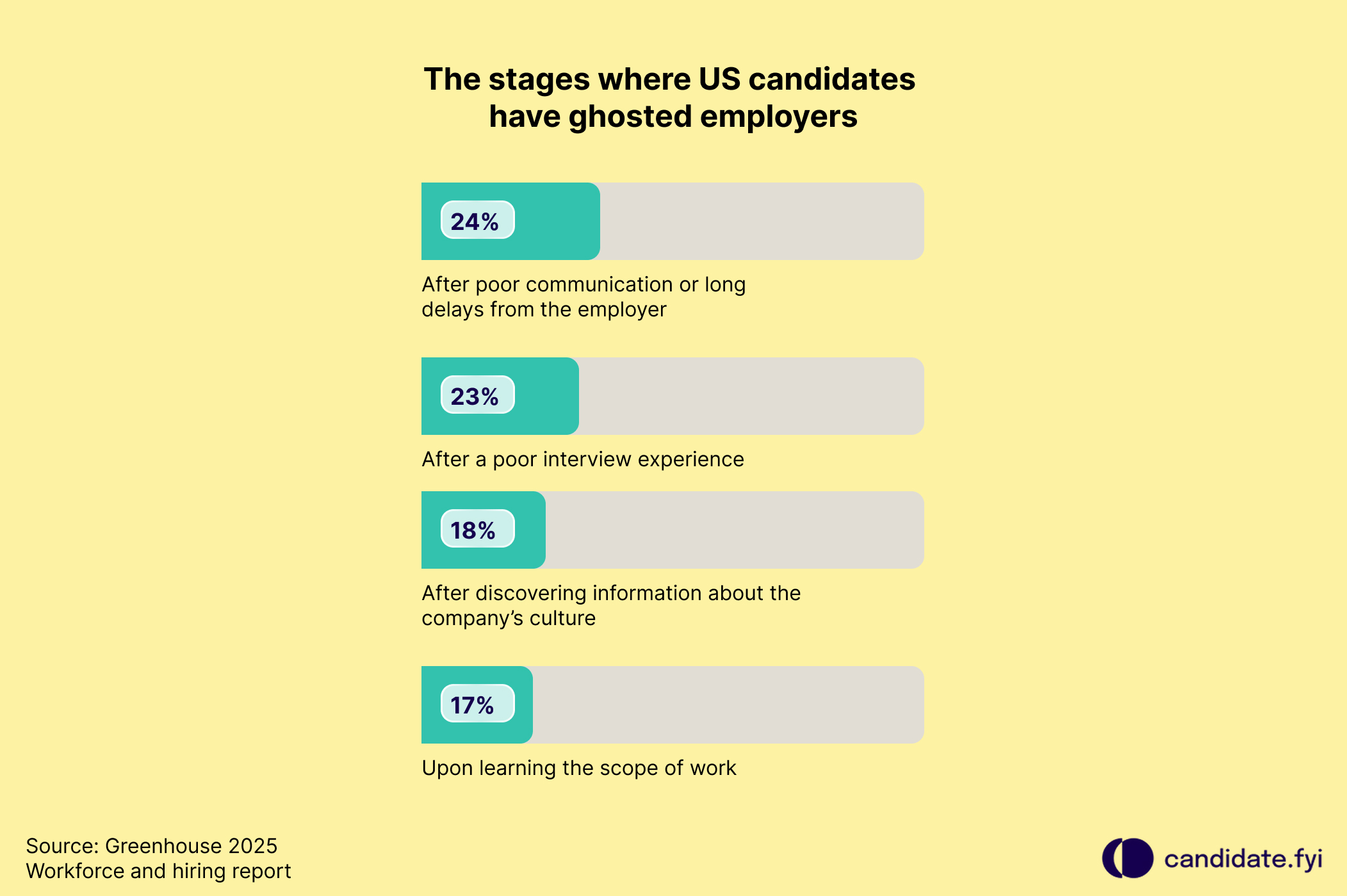
The most damaging finding is that ghosting is not primarily a candidate motivation problem. It is a process problem. When candidates disappear because of slow communication, the fault lies with the system, not the individual.
Candidates do not experience "time to schedule" as an operations metric. They experience it as silence during a stressful job search. When that silence stretches for days, they accept another offer or disengage entirely.
The Monday Problem
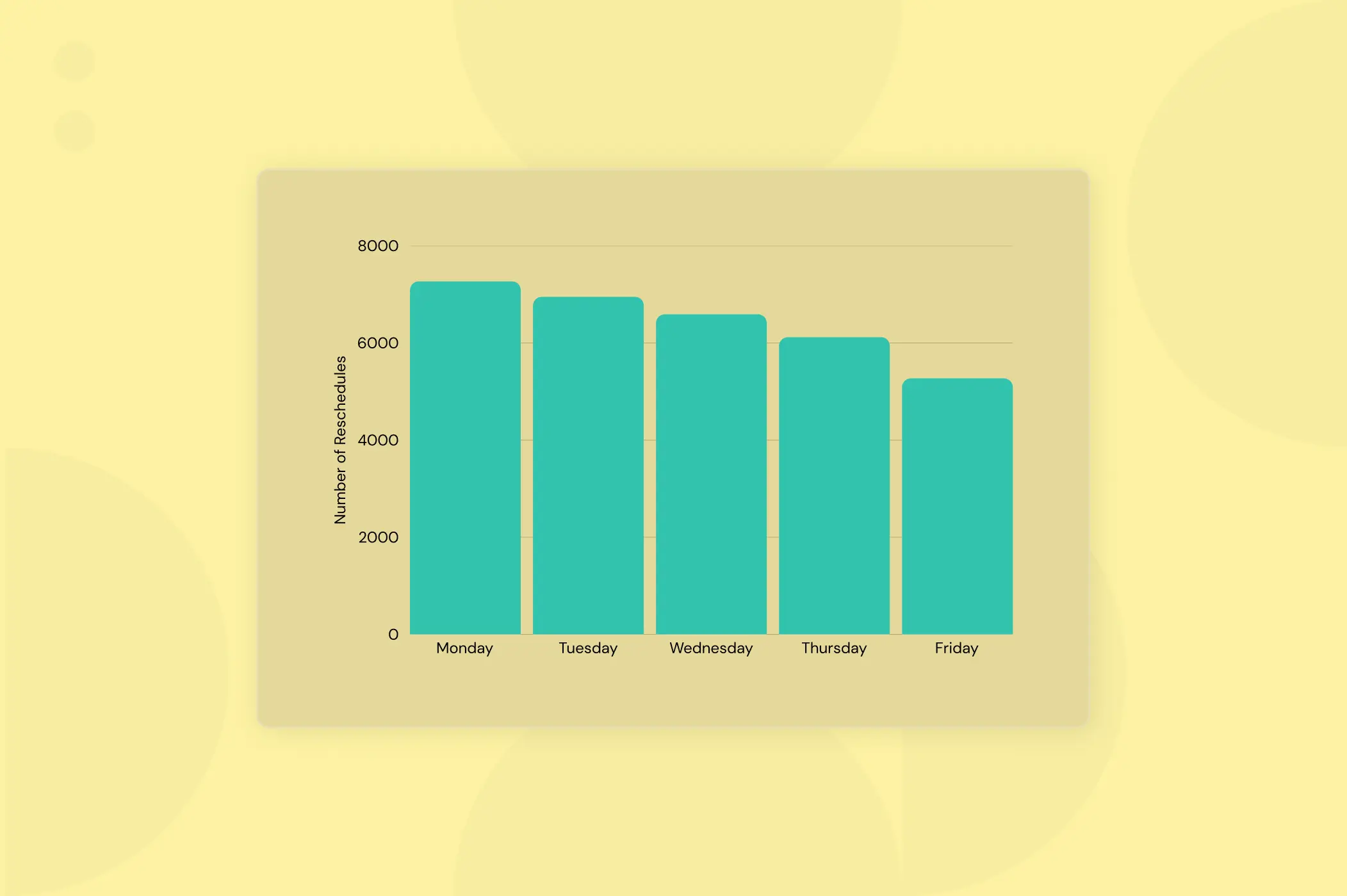
Coordination chaos is not evenly distributed across the week. Our data from the Recruiting Coordination Wrapped 2025 report reveals a clear pattern.
5,409 – Interviewer declines on Monday
3,495 – Interviewer declines on Friday
40% – More chaos on Mondays compared to any other day

Mondays bring the highest volume of declines, reschedules, and coordination failures. Teams walk into the office facing a backlog of conflicts, cancellations, and last-minute changes that accumulated over the weekend.
Manual coordination teams spend Mondays drowning in rework. Automated teams let the AI agent handle the clean-up while coordinators focus on higher-value work.
The "Slow No" Bottleneck
One of the most damaging coordination delays is the time it takes for interviewers to decline invites.
68 hours – Average time for interviewers to decline manually (nearly 3 days)
21 hours – Average time to decline with AI assistance
3x – Speed improvement with automated chasing
When an interviewer ignores an invite, they block that time slot for days. This creates a "dead zone" where coordinators cannot offer that time to other candidates, even though the interviewer has no intention of accepting.
The delay cascades. One slow decline forces the coordinator to rebuild the entire panel, which delays the candidate, which increases the risk of losing them to another offer.
Kyle Connors, co-founder of candidate.fyi, explains how automation solves this:
fyi proactively engages interviewers via Slack and email. This automated chasing forces a decision, cutting the decline time by 3x.
The 14% Churn Rate
Coordination work is not just about building schedules. It is about rebuilding them when plans change.
14% – Percentage of all interviews that get rescheduled
7,267 – Peak reschedule volume on Mondays
Life happens. Hiring managers get sick. Candidates have conflicts. Interviewers realize they are double-booked. The data shows a consistent 14-15 percent reschedule rate across all interview types, which means roughly one in seven interviews requires rework.
For high-volume teams, this becomes a tidal wave. Mondays alone bring over 7,000 reschedules that need to be managed, communicated, and resolved.
Manual teams treat this churn as unavoidable overhead. Automated teams use AI agents to handle the "Calendar Tetris" instantly, freeing coordinators to focus on candidate relationships and process improvements.
Shalik W., Recruiting Coordination Lead at Discord, described the shift:
That's the hope for the future is those repetitive tasks AI can help with, so we can work on the big picture.
Schedule 153 Interviews Per Week with AI
That's 5X higher than the industry average. When recruiting coordinators can only schedule ~30 interviews per week, candidates wait longer and your team falls behind.
The Solution: Key Statistics on Automated Interview Scheduling
The Capacity Unlock
The most striking finding from the Recruiting Coordination Wrapped 2025 report is the dramatic difference in throughput between manual and automated coordination.
158 interviews per week – Capacity of an AI-enabled recruiting coordinator
~30 interviews per week – Capacity of a manual coordinator
5x – Capacity multiplier with automation

This is not a marginal improvement. It is a complete transformation of what one coordinator can accomplish.
The 5x multiplier comes from removing the micro-delays that compound across every interview loop. In manual scheduling, each step waits for a person to notice, decide, and act. Those pauses stack across dozens of candidates, creating the bottleneck that limits throughput.
When an AI agent handles confirmations, reminders, conflict checks, and rescheduling logic, those pauses shrink dramatically. The system does not need to wait for a coordinator to check their inbox, prioritize tasks, and send the next message.
The Workload Split
One of the most important insights from our data is how automation redistributes coordination work across the system.
46% – Tasks handled by AI agent
26% – Tasks handled by candidates through self-service
28% – Tasks handled by recruiting coordinators
This distribution is the heart of the "5x throughput" story. Nearly half of the coordination pressure moves into automation, a meaningful chunk moves into candidate self-service, and coordinators retain control over the work that actually benefits from human judgment.
Jeremy Lyons, a recruiting operations consultant, sees this shift creating entirely new roles:
We're going to see new roles emerge, including this recruiting engineer concept, where highly technical people sit inside recruiting operations. They are not traditional software engineers, but the tools and knowledge have become democratized enough that teams can build and configure their own systems.
When coordinators are freed from repetitive execution, the role naturally evolves toward strategy, data analysis, and system design.
Speed Improvements That Matter
Speed is not just an efficiency metric. It is a competitive advantage in talent markets where candidates are evaluating multiple offers simultaneously.
76% – Improvement in scheduling speed at Relativity Space (from 2.8 days to 16.2 hours in 6 weeks)
50 minutes – Median time to accept an interview invite with AI assistance
Cory O'Brien, who leads talent operations at Relativity Space, described the impact:
In our first month, we averaged 2.8 days to schedule interviews. Now, just halfway through month two, we've reduced that to 16.2 hours — a 76% improvement in a very short amount of time.
That speed improvement translates directly into better candidate experience. Faster confirmations reduce the silence that makes candidates disengage. Quicker recovery from reschedules keeps the process moving when calendars change. Shorter gaps between interview stages maintain momentum and reduce drop-off.
Candidate Satisfaction Improves With Automation
The data challenges the narrative that AI destroys candidate trust. Our Recruiting Coordination Wrapped 2025 report shows the opposite.
4.63 / 5 – Recruiter screen score (often the most automated step)
4.41 / 5 – Overall pulse score (up from 4.32 last year)
4.22 / 5 – Hiring manager score (more manual coordination, lower satisfaction)

Notice the pattern: recruiter screens, which often use self-scheduling, have the highest satisfaction score. Hiring manager interviews, which involve more manual coordination and potential rescheduling, score lower.
Speed is the new empathy. When automation removes delays and creates clarity, candidates experience the process as organized and respectful of their time.
Nitin Moorjani, a recruiting operations leader, explains the connection:
Reporting in recruiting has always been low level. You cannot see how many interviews you run each week or how much load sits on each coordinator. When you connect scheduling to candidate experience scores, everything becomes clear.
The Transformation: From Calendar Tetris Champion to Recruiting Engineer
The statistics tell a clear story about where coordination is headed.
62% – Percentage of HR teams operating beyond capacity (Greenhouse)
32% – Increase in application volumes
You cannot hire enough coordinators to solve a problem that scales exponentially. When application volume rises by a third while teams are already beyond capacity, adding headcount is not a sustainable strategy.
The teams that are winning this fight are transforming the role itself. They are moving recruiting coordinators from invisible executors who manage calendars to strategic advisors who design workflows, analyze bottlenecks, and use data to drive hiring outcomes.
Jeremy Lyons sees this happening across the industry:
We really started talking about this recruiting engineer role... where you have highly technical people sitting in a [recruiting] spot.

When coordinators are not drowning in admin work, they gain the capacity to focus on the work that actually moves the business forward: building candidate relationships, coaching interviewers, identifying process improvements, and managing employer brand strategies.
What the Data Means for Talent Teams
The statistics in this post reveal a coordination crisis that cannot be solved with heroics or headcount. The system itself has become the constraint.
Manual coordination breaks down when application volume rises, budgets stay flat, and tools cannot adapt to real human behavior. The delays, reschedules, and communication gaps create a candidate experience that feels slow and disorganized, which leads to ghosting, drop-off, and lost talent.
Automated interview scheduling changes the operating model. When AI recruiting tools handle the repetitive work that consumes 46 percent of a coordinator's day, the entire system speeds up. Interviews get scheduled faster, declines surface sooner, reschedules get managed instantly, and coordinators gain capacity to focus on strategy.
The teams that embrace this shift are not just moving faster. They are redefining what the recruiting coordinator role can accomplish and building a hiring process that scales with demand rather than breaking under pressure.
The era of Calendar Tetris is over. The future belongs to intelligent coordination and recruiting coordinators who can design systems rather than just execute schedules.
Questions & Answers
Why does interview scheduling take so long manually?
Manual interview scheduling averages 243 minutes per interview because the process involves constant back-and-forth communication, context switching, and waiting for responses from multiple people. The delays compound across dozens of candidates each week because each step depends on humans responding on their own timeline. Self-scheduling reduces this to 27 minutes by removing the manual coordination loops entirely, creating a 9x speed improvement.
How does slow interview coordination affect candidate experience?
The data shows a direct connection between coordination delays and candidate ghosting. Fifty percent of candidates have ghosted employers, and 24 percent cite slow communication or long delays as the primary reason. When interviewers take 68 hours (nearly 3 days) to decline invites manually, it creates a "dead zone" where recruiting coordinators cannot move forward with other candidates. This silence during a stressful job search causes candidates to accept competing offers or disengage entirely.
What can a recruiting coordinator do with AI recruiting tools?
Data from enterprise talent teams shows that AI-enabled recruiting coordinators can handle approximately 158 interviews per week, compared to roughly 30 interviews per week for coordinators managing schedules manually. This 5x capacity multiplier comes from AI agents handling 46 percent of coordination tasks autonomously, including confirmations, reminders, conflict checks, time zone adjustments, and rescheduling logic.
What is the biggest bottleneck in interview coordination?
The "slow no" is one of the most damaging bottlenecks in interview coordination. When interviewers ignore or delay declining interview invites, they block time slots for an average of 68 hours (nearly 3 days) in manual systems. This creates a cascading delay where recruiting coordinators cannot offer that time to other candidates, rebuild interview panels, or maintain scheduling momentum. Automated interview scheduling solves this by proactively engaging interviewers via Slack and email, forcing a decision and cutting decline time to 21 hours.
More Articles
What Is Recruiting Automation? A Practical Guide for Enterprise TA Teams
Recruiting automation covers 6 key workflows. Learn how enterprise TA teams use it to schedule 5x more interviews and cut manual admin by 46%.
.webp)
Decoding Candidate Experience Data - Insights into the Interview Experience
In the dynamic landscape of modern recruitment, understanding candidate experience is crucial for any organization aiming to attract and retain top talent. One powerful tool in this endeavor is the pulse survey feature offered by candidate.fyi. These surveys enable candidates to provide valuable feedback on their interview experiences, painting a vivid picture of the recruitment process. In this post, we will delve into the aggregate results of these surveys, offering insights into the different stages of the interview process.

Enhancing Candidate Experience: Top Interview Scheduling Strategies
Unlock the secrets to enhancing candidate experience with top interview scheduling strategies in our comprehensive blog post. Learn how to optimize scheduling to improve communication, personalize interactions, and integrate technology, thereby boosting candidate satisfaction and positioning your company as a top employer choice.