We entered 2026 with a strange contradiction in hiring. Teams have more recruiting technology than ever, yet candidates disappear more often than most leaders want to admit.
Greenhouse reports that 50 percent of candidates have ghosted employers. When you look closer, the story gets more uncomfortable, because the biggest driver is not candidate intent, compensation, or job fit. It is friction.
In the same Greenhouse report, 24 percent of candidates who ghosted say they did so because of slow communication or long delays. Greenhouse also found that 63 percent of candidates in the United States were ghosted after a job interview, and 73 percent of Gen Z candidates have ghosted employers, which hints at a growing expectation for follow-through.
That data points to a simple truth most coordinators already live every day. Candidate trust is fragile, and the process usually breaks at the exact moment candidates care the most.
This article breaks down the top five reasons candidates ghost, and it shows how enterprise teams can fix each one using a combination of process design and modern tools such as automated interview scheduling, a real candidate experience platform, and integrations that help teams close the loop faster.
Summary
Candidates ghost when the hiring process stops feeling alive. That usually happens when the system cannot keep up with human behavior, and when updates arrive late, incomplete, or not at all.
Greenhouse data shows that half of candidates have ghosted employers, and the most common trigger is slow communication or long delays (24 percent). The fix is to reduce the number of moments where a candidate has to guess what is happening.
In practice, that means building a workflow where scheduling and follow-up happen reliably, even when interviewers reschedule, candidates change availability, and teams are running many loops at once. This is where interview scheduling software and a strong interview scheduler help, because they remove the coordination bottlenecks that cause long gaps.
When teams reduce time to schedule and increase clarity after interviews, ghosting becomes less likely because candidates feel momentum and direction.
Why does candidate ghosting happen at enterprise teams?
Ghosting is often explained as a candidate behavior problem, but the day-to-day reality inside enterprise recruiting looks different.
Coordinators are trying to run a dynamic, human process through systems that were never designed for constant exceptions. A hiring manager blocks half their calendar for “focus time,” then moves three meetings the morning of the panel. A candidate is juggling work and other interviews, so they respond late, or only respond outside business hours. A recruiter is ready to move, but cannot find the latest status because updates are scattered across email, Slack, and documents.
Each of those events looks small, but they create compounding delays.
Those delays change how candidates interpret the process. Candidates rarely see the internal complexity. They see a company that asked for their time, then went quiet.
The longer the gap, the more likely they are to protect themselves by disengaging. That is why Greenhouse’s numbers point so strongly toward delay as a primary trigger. Candidates often do not drop because they suddenly dislike the job; they drop because the process stops providing clear signals.
For Gen Z candidates, the tolerance for ambiguity is even lower. Many grew up in systems that provide immediate confirmation, immediate status visibility, and immediate next steps. When an interview process creates uncertainty, it reads as disorganization.
What ghosting looks like inside a hiring funnel
Talent teams often picture ghosting as a candidate simply failing to show up, but the more common pattern is quieter. It starts with enthusiasm.
A typical scenario begins right after an interview is scheduled. The candidate receives a calendar invite, but the interview gets rescheduled. Nobody sends context and the candidate wonders if they should prepare differently.
Another pattern happens after the interview itself. A senior candidate, who attended five interviews, sends a thank-you note after every interview and days pass without a meaningful update. Even when the recruiter intends to respond, the recruiter may be waiting on feedback, or waiting on a decision-maker, or waiting for scheduling capacity for the next round.
From the candidate’s perspective, the company asked for energy and attention, then failed to match it.
Greenhouse’s post-interview statistic is a signal worth sitting with. When 63 percent of candidates say they were ghosted after an interview, it suggests that many organizations lose control in the later stages, which is the stage where candidate interest is often highest. This is also where workload spikes for coordinators, because late-stage loops tend to involve more stakeholders. Therefore, more human behavior to handle.
The operational reality is that the same factors that slow scheduling also slow follow-up. When a team spends hours rebuilding loops and chasing calendars, they have less time to send clear updates, and those updates become less consistent.
Reason 1: Slow communication and long delays
Greenhouse reports that slow communication or long delays drive 24 percent of candidate ghosting. That number is revealing because it has very little to do with job fit. It points to a failure of process responsiveness.
Delays often form in predictable places. The candidate submits availability, then waits while a coordinator tries to align calendars across several people. The interview happens, then the candidate waits while feedback is collected, summarized, and turned into a decision.
Those waiting windows can stretch from hours into days, and each day increases the chance that the candidate emotionally moves on.
How to fix it with automated interview scheduling:
Enterprise teams reduce delay by removing the repetitive coordination work that creates bottlenecks. This is where automated interview scheduling becomes more than a booking link. A booking link can help a candidate pick a time, but enterprise delay is usually created by exceptions and handoffs. Those are the moments automation must cover if a team wants to reduce ghosting.
A modern interview scheduler should keep the process moving even when people behave unpredictably. When the system can confirm a step immediately, it should do that. When the system can send a reminder at the right time, it should do that. This “always-on responsiveness” is the practical antidote to the waiting windows that cause candidates to disengage.
candidate.fyi’s approach fits this model through its scheduling automation and AI assistance. Features such as an AI Scheduling Summary help coordinators stay aligned on constraints, status, and availability without chasing context across tools. The fyi AI Agent can handle candidate outreach and reminders, and it can maintain a shared task queue so the team has visibility into what is happening.
What improves, and how to measure it:
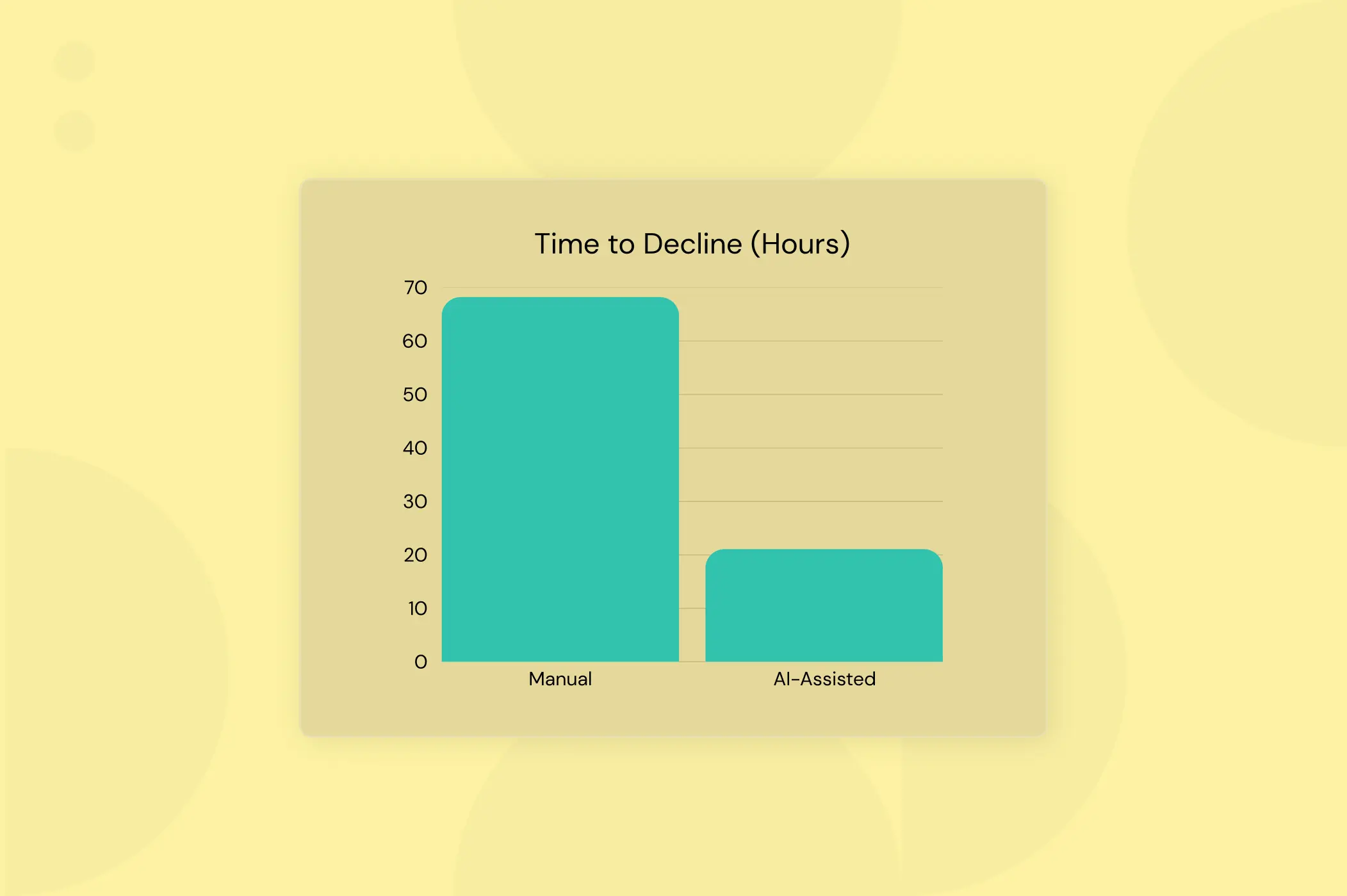
Delay becomes measurable when you track time to schedule as a true process KPI. Our customer data shows when candidates self-schedule, time to schedule drops to 26.8 minutes. When teams rely on availability collection, time to schedule increases to 243.19 minutes.
Unlock the Future of Recruiting— Book a Demo Today!


Reason 2: A poor interview experience
Greenhouse reports that 23 percent of ghosting happens after a poor interview experience. Most leaders interpret this as an interviewer quality issue, but in many cases the experience feels poor because the system is the problem.
Candidates notice when interviewers appear unprepared, when the conversation repeats questions that should have been covered already, or when the panel seems misaligned on what the role actually needs.
A candidate can forgive a single awkward moment. What they rarely forgive is a pattern that suggests the organization cannot run its own process.
How to fix it with a candidate experience platform:
This is where a candidate experience platform becomes practical, because it turns “clarity” into a consistent system behavior. Candidates benefit when they have one place to understand the schedule, the purpose of each conversation, and how to prepare. They also benefit when the platform makes change feel predictable, because updates are communicated clearly, and the candidate can see what changed and why.
candidate.fyi’s candidate portal is designed for this type of clarity. It centralizes interview schedules, prep materials, interviewer context, and next steps. When candidates can return to a single hub throughout the journey, they do not have to hunt for scattered messages across threads and calendar invites.
Reason 3: Compensation clarity arrives too late
Greenhouse reports that 22 percent of candidates ghost after being told the salary. In many organizations, compensation becomes a late-stage conversation, and late-stage surprises create emotional whiplash.
Candidates begin to imagine the role, the team, and the future, then they learn the range and realize it does not match their expectations. At that point, the easiest exit is silence.
How to fix it through earlier alignment and cleaner messaging:
The practical fix is to introduce clarity earlier, and to make the messaging consistent across recruiters, coordinators, and hiring managers. When candidates hear a range early and hear it the same way each time, the process feels more trustworthy. When candidates hear shifting numbers late, or hear uncertainty about comp, they interpret it as risk.
Scheduling tooling affects this indirectly, because faster, cleaner scheduling tends to compress timelines and reduce drift. When a process moves briskly and predictably, teams tend to make earlier decisions about what needs to be clarified, including compensation.
Reason 4: They found a better opportunity while waiting
Greenhouse reports that 22 percent of candidates ghost after finding a better opportunity. In most cases, the better opportunity did not “win” solely because it was better, it won because it moved faster, communicated more clearly, or created more confidence.
Candidates rarely pause their job search because they had a good first interview. They pause when they see evidence that a company is serious.
Speed matters here, but the deeper driver is momentum. Momentum is the feeling that the process is alive, and that the company knows how to move.
How to fix it with an interview scheduler:
For many teams, the ATS is the system of record. The fix comes from combining the ATS structure with an interview scheduling software layer that handles the coordination complexity in real time. When the scheduling layer reduces reschedules, handles time zones, and keeps the loop intact when an interviewer cancels, candidates move through the funnel with fewer interruptions.
candidate.fyi’s automation is built for those interruption points. AI Auto-Replacement works because cancellations are not rare, and they are one of the fastest ways to create a candidate confidence drop. But when the system finds a replacement quickly, updates calendars, and communicates why it happened, the candidate experiences continuity.
What improves, and how to measure it:
Momentum shows up in “time to interview,” not only “time to schedule.” Our customer data shows when candidates self-schedule, time to interview drops to 3.9 days. When teams rely on availability collection, time to interview increases to 5.9 days.
Reason 5: They ghost after receiving an offer
Greenhouse reports that 20 percent of candidates ghost after receiving a job offer.
This surprises people until they remember how offers unfold in enterprise environments. Approvals, compensation alignment, background checks, and internal sign-offs can create gaps that feel like silence. Candidates interpret those gaps as uncertainty.
How to fix it with visible follow-through:
The fix is a more disciplined offer-stage communication cadence, and better internal visibility into what is happening. When teams know the status, they can communicate confidently and early.
This is where AI tools can reduce internal confusion. candidate.fyi’s AI Scheduling Summary help teams stay aligned across the moving parts of coordination. Candidates need to feel the process moving, and internal teams need a clear view of what is blocking movement.
How does automated interview scheduling reduces ghosting?
Ghosting rises when the process accumulates dead time. Dead time forms when humans have to coordinate manually because manual coordination contains delays that are not obvious in isolation.
Each waiting period creates a new opportunity for candidates to lose confidence and pursue alternatives.
Automated scheduling reduces dead time by turning common coordination steps into immediate actions and by catching exceptions early enough. That is why a strong recruiting coordination tool changes outcomes without requiring recruiters to work harder.
In practice, this often means a system that can manage confirmations, reminders, conflicts, and replacements without creating new work for coordinators, while also keeping candidates informed in real time. When those behaviors become consistent, the process feels stable, and candidates stay engaged.
What should talent teams expect now?
Candidate ghosting is becoming a structural challenge, especially for high-volume teams, because candidate expectations keep rising while operational complexity keeps growing. In 2026, more teams will treat ghosting as a downstream metric of process health.
They will stop blaming candidates, and they will start measuring the operational inputs that cause silence.
Teams that win this year will treat scheduling and follow-up as product problems. They will invest in interview scheduling software that can handle real-world exceptions, and they will strengthen the candidate experience platform layer so candidates always know what is happening.
When that shift happens, teams do not just reduce ghosting. They hire faster, reduce coordinator burnout, and build a hiring experience that candidates talk about with their friends.
Questions
Why do candidates ghost employers during hiring?
Candidates usually ghost when the process stops feeling predictable. Long gaps between messages, unclear next steps, and repeated rescheduling create uncertainty, and uncertainty makes candidates disengage. Greenhouse data suggests that delays and poor communication are the most common trigger, followed by poor interview experiences and late-stage surprises like compensation misalignment.
What are the top reasons candidates ghost after an interview?
Many candidates ghost after an interview because follow-up is slow or unclear, and the candidate cannot tell whether they are still being considered. In practice, post-interview ghosting often comes from internal bottlenecks, such as delayed feedback collection, unclear ownership of next steps, or scheduling friction for the next round.
How does automated interview scheduling reduce candidate ghosting?
Automated interview scheduling reduces ghosting by shrinking the waiting windows that cause candidates to lose confidence. When scheduling confirmations, reminders, conflict checks, and reschedule handling happen automatically, candidates receive faster updates and the process keeps moving even when calendars change.
What is are interview scheduling tools, and what should enterprise teams expect it to do?
Interview scheduling software is designed to coordinate complex loops across interviewers, time zones, and stages. In enterprise hiring, it should handle frequent exceptions, maintain visibility into status, reduce manual back-and-forth, and recover quickly from cancellations so the candidate experience stays stable.