Find out where your team stands. Take the recruiting coordination maturity assessment here.
Interview scheduling determines whether you land top talent or watch them disappear into a competitor's pipeline. The difference between a fast, seamless scheduling experience and a slow, chaotic one often comes down to a single factor that most talent acquisition leaders overlook: coordination maturity.
Teams treat interview scheduling as a tactical problem. They hire more coordinators. They ask recruiters to work faster. But effort alone cannot solve a structural problem. When your interview schedule breaks under pressure, the issue is not willpower. The issue is maturity.
The recruiting coordination maturity model provides a diagnostic framework that helps talent acquisition teams understand where they are today, what capabilities they are missing, and how to progress intentionally rather than reactively. This is the most important classification system that reveals why those outcomes happen in the first place.
Summary
Recruiting teams are struggling with slow interview scheduling, and the problem is maturity of their coordination mindset. This framework introduces five distinct levels of interview schedule optimization, from manual chaos to autonomous coordination. Teams at Level 1 spend 4+ hours scheduling each interview. Teams at Level 5 schedule in 27 minutes and handle 5x the volume. Understanding where you are today determines what you fix next.
What Is Interview Schedule Maturity? (And Why It Matters for Candidate Experience)
Interview schedule maturity measures how well a recruiting team can handle the core mechanics of coordination: scheduling interviews, managing reschedules, communicating with candidates, and keeping everyone informed. Teams with low maturity operate reactively, manually rebuilding schedules every time something changes. Teams with high maturity operate proactively, using automation and intelligent systems to absorb the inevitable friction of human behavior.
Maturity is not the same as size. A ten-person startup can operate at Level 4 maturity if they have the right process and tools. A thousand-person enterprise can operate at Level 1 if they rely on email chains and spreadsheets. Maturity is about capability, not scale.
The reason interview schedule maturity matters is that it directly impacts the two metrics that recruiting leaders care most about and the bottom line: hiring speed and candidate experience. Teams that mature their coordination function schedule interviews faster, reduce time-to-hire, and deliver better experiences to candidates.
Greenhouse reports that 50 percent of candidates have ghosted employers. Among those candidates, 24 percent cite slow communication or long delays as the reason they withdrew. These are not candidates who dislike the role or the company. It’s more likely that they wanted the job. However, candidates get frustrated by the scheduling process itself and the time it takes until they receive any answer. The interview schedule becomes the breaking point.
When a candidate waits days for a coordinator to find available time, or when an interview gets rescheduled twice because of poor planning, the message they receive is clear: this company does not have its act together. Candidate experience does not start when the interview begins. Candidate experience starts the moment communication and scheduling begin.
Why Interview Scheduling Is Harder in 2026
The pressure on recruiting coordination has reached a breaking point. Three forces are colliding to make interview scheduling more difficult than it has ever been.
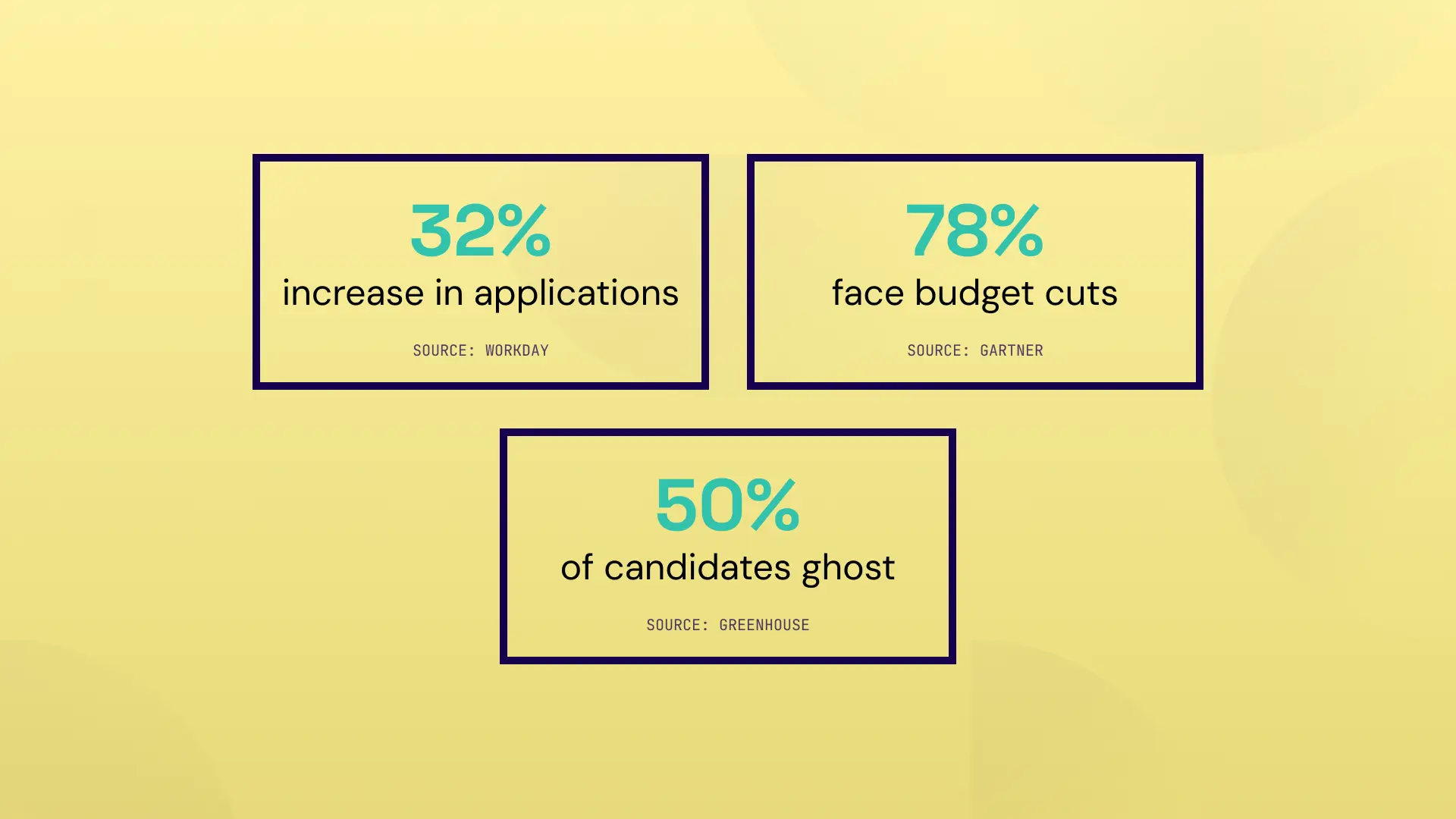
First, application volume has surged while open roles have declined. Workday reports a 32 percent global increase in job applications, while open roles have dropped by 13 percent. A smaller number of roles is attracting a much larger number of applicants. This paradox means recruiters are reviewing more resumes and preparing more interview loops than before, even though their hiring needs have not grown.
Second, recruiting budgets are shrinking. Gartner reports that 78 percent of recruiting leaders face stagnant or shrinking budgets. Many teams operate with fewer resources while the workload increases. The resource squeeze creates a gap that cannot be solved with extra effort. When a recruiting coordinator is juggling several hundred candidates, hundreds of emails, and dozens of interview loops across teams and time zones, there is not enough business hours in the week to solve this dilemma.
Third, candidate expectations have shifted. Candidates now expect speed and transparency. In 2026, they expect to know who they are meeting with, what they need to prepare, and the next steps in the hiring process. When that information is delayed or fragmented, they leave.
This means that the coordination experience has become a competitive differentiator. Teams that deliver fast and transparent hiring processes retain the interest of top talent.
The 5 Levels of Interview Coordination Maturity
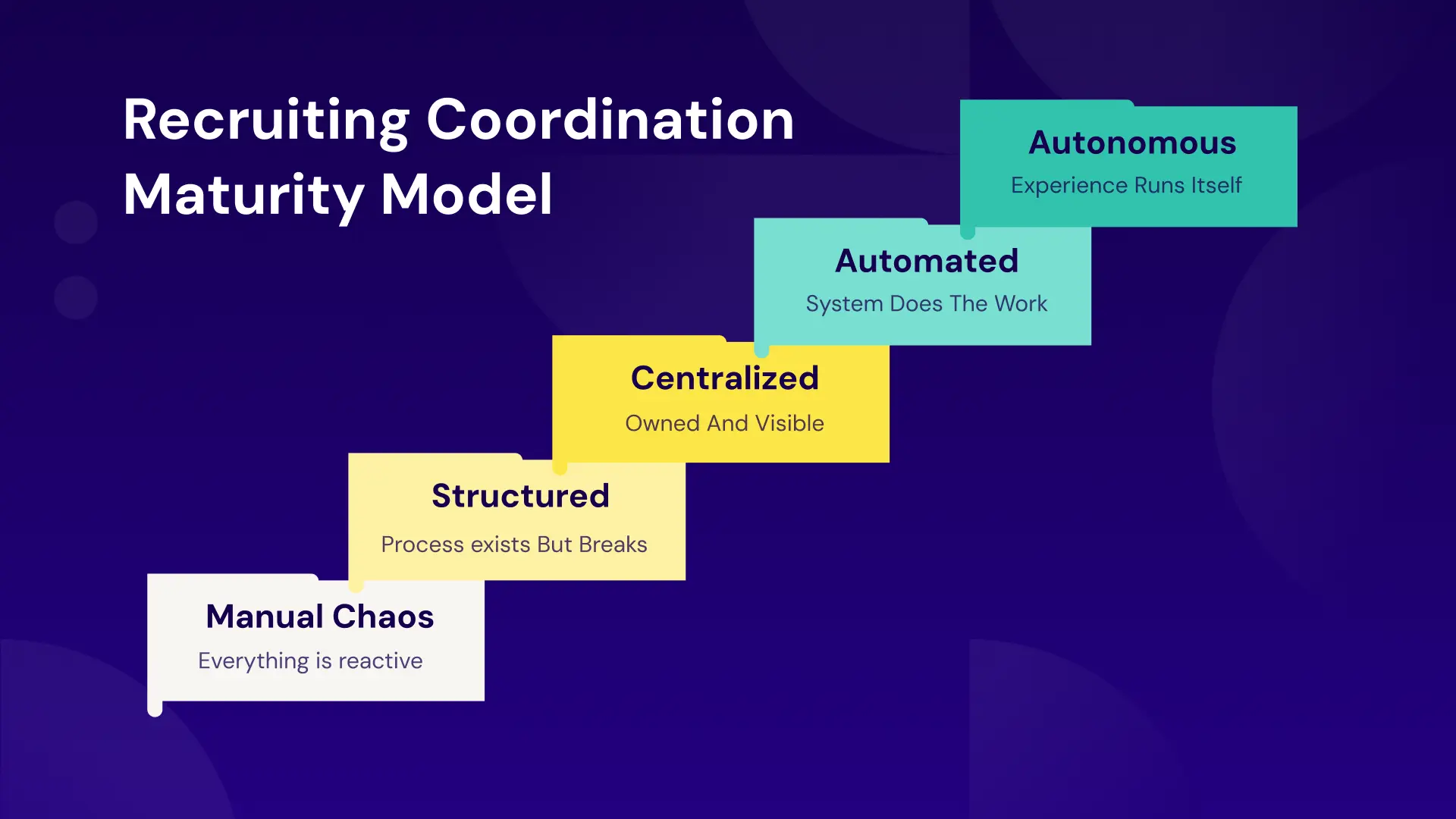
To solve this problem, we have interviewed talent leaders from Discord, Peloton, Intercom, and more to create a model to help talent acquisition teams improve their recruiting and hiring operations. Interview coordination maturity progresses through five distinct levels. Each level represents a different capability set, a different set of outcomes, and a different way of thinking about the work.
Teams do not skip levels. A team operating in manual chaos cannot jump directly to autonomous coordination. They must build the foundational capabilities at each stage before they can progress to the next. Understanding where your team sits today determines what you fix next.
Level 1: Manual Chaos — When Interview Schedules Break Constantly
At Level 1, everything is reactive. Recruiting coordinators spend their entire day in email, manually chasing availability from candidates and interviewers. Interview schedules break constantly due to last-minute conflicts, forgotten calendar blocks, or late responses. There is no single source of truth. Information lives in email threads, Slack messages, personal notes, and scattered ATS screens.
Candidates frequently ask when their interview is happening or who they are meeting with because communication is fragmented. Interviewers miss interviews or show up unprepared because they forgot to view the candidate’s resume.
Teams at Level 1 are trapped in what the Interview Scheduling Gap Report calls "Calendar Tetris." Coordinators spend 46 percent of their time on admin tasks, specifically scheduling or fixing interviews. Much of this time is spent trying to fit people together like puzzle pieces, manually checking calendars, sending availability requests, waiting for responses, and starting over when someone declines.
The outcomes at Level 1 are predictable.
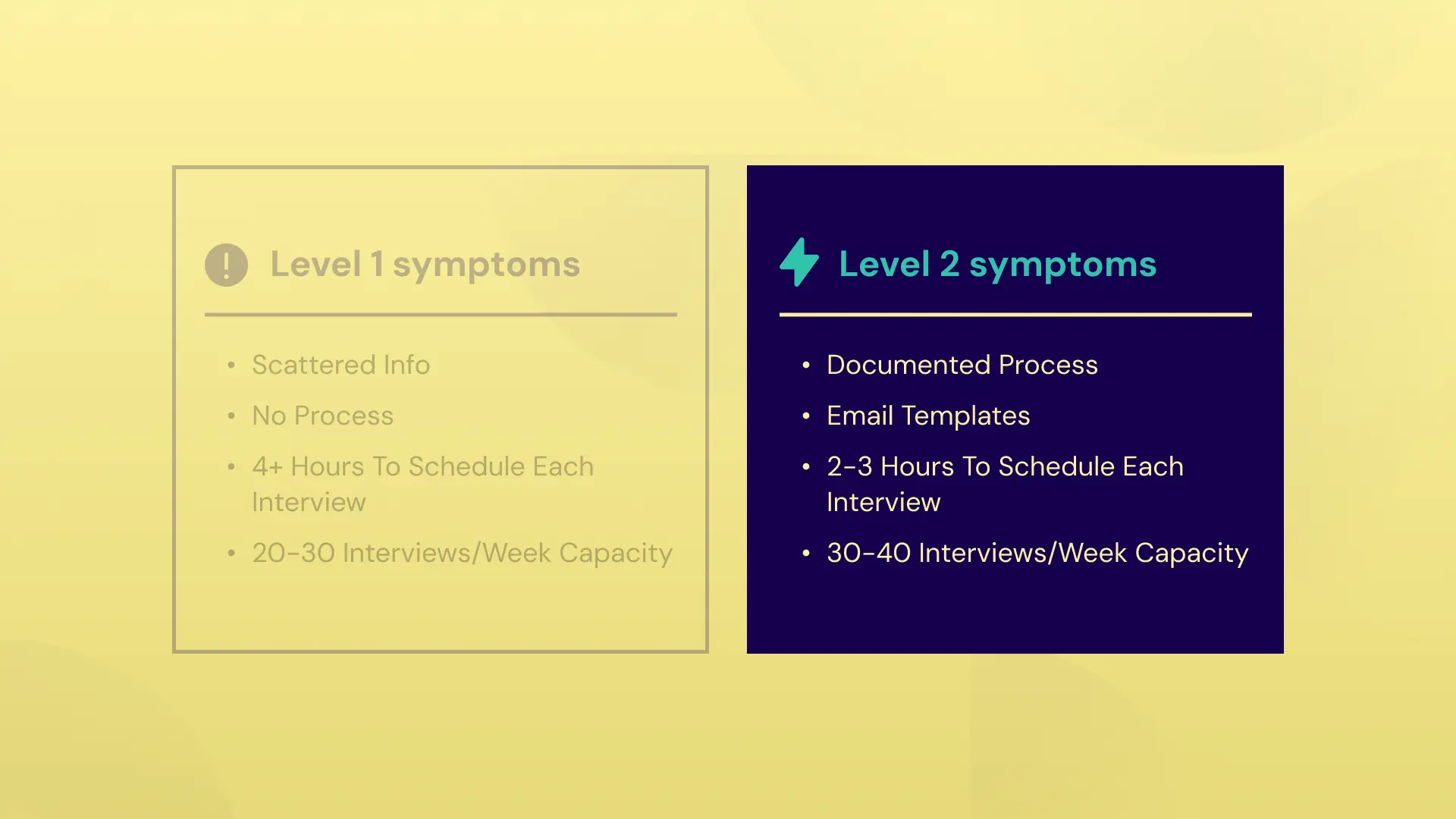
- Time-to-schedule averages four hours or more per interview.
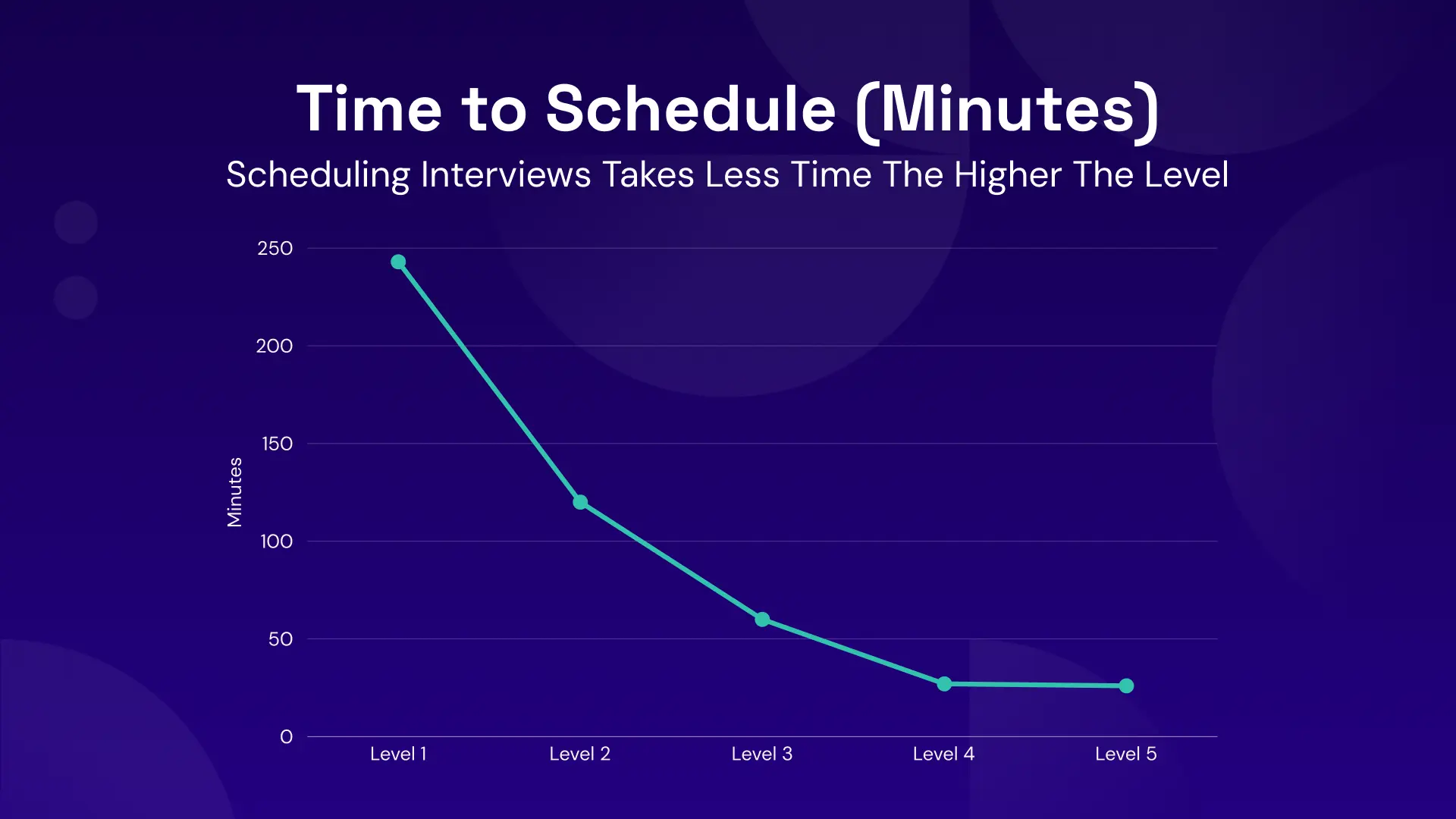
- Internal data from candidate.fyi shows that manual scheduling costs teams 243 minutes per interview.
- Candidate satisfaction is low, sitting at 1-2/5 for the candidate satisfaction score, IF they can get responses.
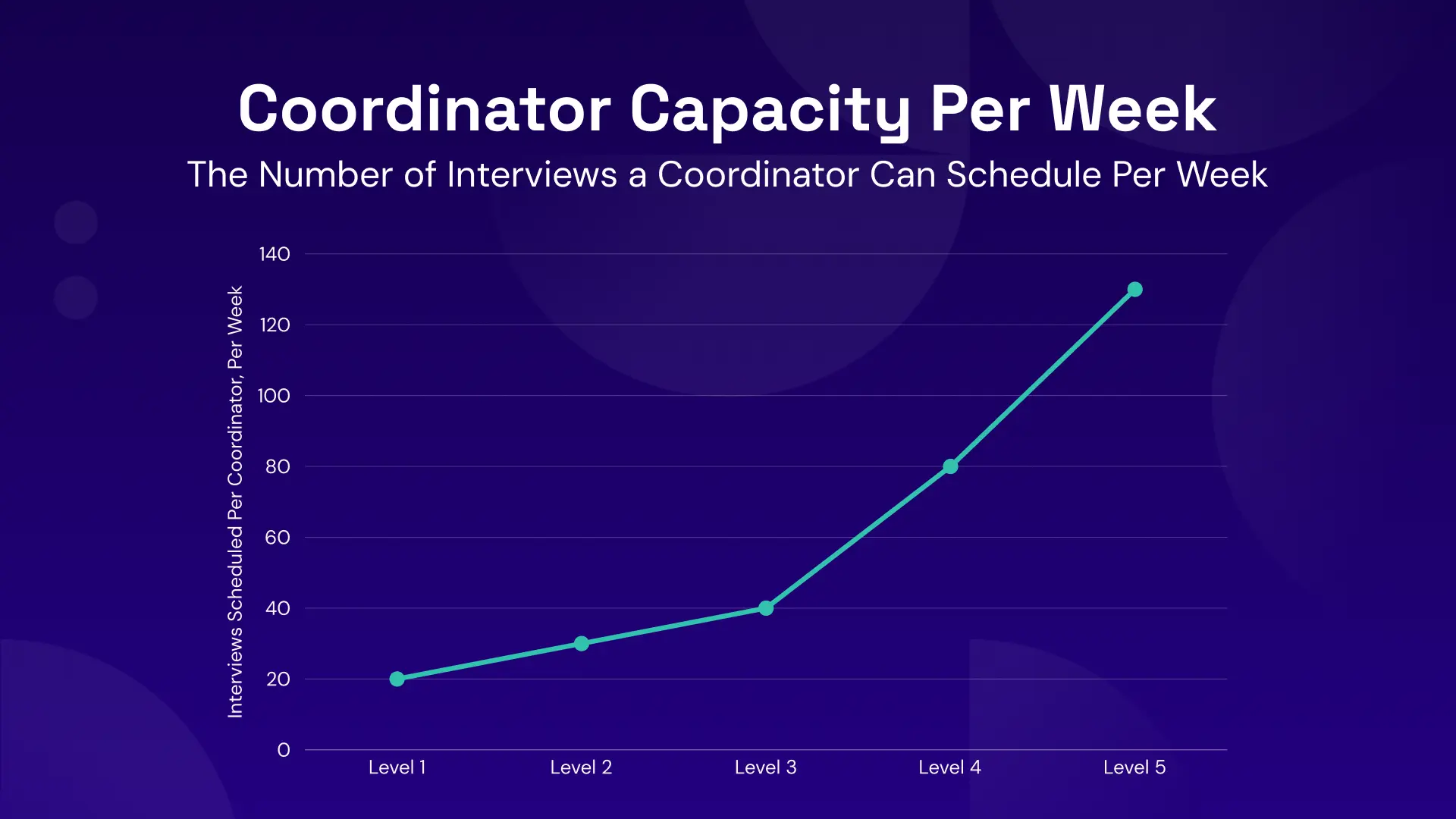
- Teams at this level average 20-30 interviews per coordinator per week, which is far below what is possible with better processes.
The breaking point at Level 1 is not a lack of tools. The breaking point is a lack of process. Teams have no documented workflows, no standardized communication, and no visibility into what is happening. Every interview is a custom negotiation. Every reschedule is a manual rebuild. Every question requires someone to dig through old emails to find the answer.
If your coordinators describe their day as putting out fires and that “interview scheduling is the worst part of the job,” you are at Level 1.
Level 2: Structured but Fragile — When Process Exists but Can't Handle Volume
At Level 2, teams have built rudimentary process. Coordinators use email templates for common scenarios like interview confirmations, reschedule requests, and candidate prep emails. Everyone knows what the standard process looks like.
When everything goes according to plan, scheduling works smoothly. But when exceptions (or human behavior) occur, the system breaks. In practice, this could look like: 1) a candidate reschedules, 2) an interviewer is suddenly unavailable, 3) or a panel needs to be rebuilt. When these situations arise, coordinators revert to manual intervention, and everything slows down again.
Teams at Level 2 typically use basic scheduling tools like Calendly or simple ATS booking features. These tools handle straightforward one-on-one bookings, but they struggle with more complex needs like panel construction, interviewer load balancing, training rules, or multi-day loops. The logic deficit of these tools means that whenever something unexpected or complex happens, the tool stops working and the coordinator must take over manually.
The outcomes at Level 2 are better than Level 1, but still fragile:
- Time-to-schedule improves to 2-3 hours per interview when things go well.
- Candidate experience is inconsistent, due to low completion rates by candidates.
- Some candidates get fast responses, especially for high-impact roles. Others wait days depending on which coordinator handles their loop or whether exceptions arise.
- Coordinator capacity remains around 20-30 interviews per week.
The system is fragile because it depends on everything going right. Reschedules happen 14 percent of the time, based on data from the Recruiting Coordination Wrapped Report. For a high-volume team, this means thousands of interviews need to be rebuilt every week. At Level 2, coordinators manually absorb that shock.
If your team has a process but coordinators still say it depends when asked how long scheduling takes, you are at Level 2. You have structured the work, but you have not centralized ownership or visibility. Different teams may follow slightly different versions of the process, and information still gets lost in email or Slack threads.
Level 3: Centralized Coordination — When Recruiting Coordinators Take Control
At Level 3, recruiting coordination becomes a defined function. Teams assign dedicated coordinators who own scheduling end-to-end and processes are standardized across all hiring teams. This is where the fun begins.
Visibility improves dramatically at Level 3. Coordinators build centralized dashboards or ATS views that show the real-time status of every candidate and interview loop. At this point, recruiters and hiring managers can see where bottlenecks are forming without asking coordinators to manually report status. Finally, candidates receive consistent updates.
The outcomes at Level 3 are meaningfully better:
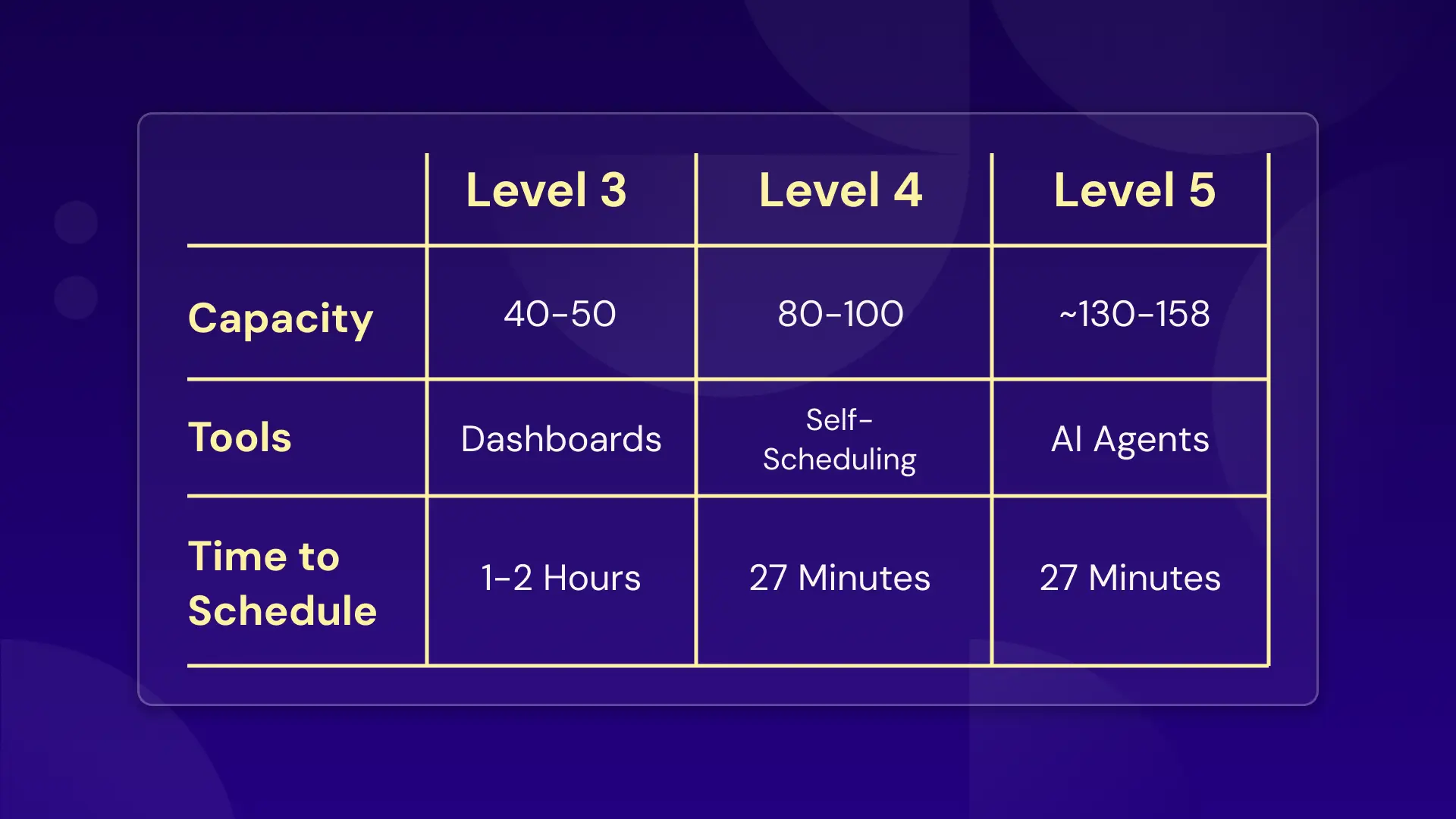
- Time-to-schedule drops to 1-2 hours per interview on average.
- Candidate satisfaction improves because communication is clearer AND there are more positive experiences, resulting in a higher completion rate for surveys.
- Coordinator capacity increases to 30-40 interviews per week due to better process discipline and visibility.
Teams at Level 3 have built a strong foundation, but they are not leveraging technology besides their ATS. This means coordinators are executing a well-defined process, but they are still doing it manually. In practice, the manual elements are, 1) every interview confirmation is a human-sent email, 2) every reschedule is a coordinator rebuilding the calendar, and 3) every candidate question is a coordinator responding individually. This limits how much volume the team can handle.
If your coordinators can tell you exactly where every candidate is in the pipeline without checking five different tools, you are at Level 3. You have centralized coordination, but humans are still doing most of the work.
Level 4: Automated Interview Scheduling — When AI Recruiting Tools Handle the Work
At Level 4, scheduling is automated. The team is leveraging AI on a basic level and are using other technology besides their ATS. Realistically this looks like: candidates who can self-schedule through a branded candidate portal that respects interviewer availability, time zones, and panel requirements in real time; AI recruiting tools that can handle panel construction, multi-step interview loops, and ATS updates automatically; and calendar intelligence that respects interviewer preferences like no meetings before ten in the morning, no back-to-back interviews, or maximum five interviews per week.
In this level, we also see Interviewer pooling that ensures if one panelist cancels, another with the same expertise and seniority automatically replaces them. From the candidate's perspective, the interview never gets canceled. The system simply finds a qualified replacement and adjusts the schedule.
Coordinators at Level 4 no longer spend their days sending confirmation emails or chasing availability. They focus on exceptions: complex multi-day loops, executive interviews, edge cases that the system cannot handle automatically. The repetitive work disappears. The strategic work remains.
The outcomes at Level 4 are transformative:
- Time-to-schedule drops dramatically to 27 minutes on average for self-scheduled interviews, based on candidate.fyi data. This is nine times faster than manual scheduling.
- Candidate satisfaction rises, due to the collection of survey responses throughout the hiring process. The Recruiting Coordination Wrapped Report shows that self-scheduled recruiter screens score 4.63 out of 5, the highest satisfaction score across all interview types.
- Time-to-interview improves from 5.9 days with manual scheduling to 3.9 days with automated scheduling.
Coordinator capacity jumps to 80-100 interviews per week because automation handles the repetitive work. This is where most candidate.fyi customers operate when they first implement the platform. Companies like Discord, Peloton, and GoPro use automated interview scheduling to remove the coordination burden from their teams.
If candidates can book their own interviews without emailing a coordinator and you are leveraging AI tools in your interview scheduling process, you are at Level 4.
Level 5: Autonomous Coordination — When the System Runs Itself
At Level 5, coordination becomes autonomous. AI agents can handle 46 percent of all coordination tasks without human intervention, based on data from the Recruiting Coordination Wrapped Report. If you are utilizing AI in this way, your team can not only hire more quickly, but the team can finally focus on strategic opportunities, such as employer brand-building and candidate experience.
If we look at autonomous coordination in practice, we see:
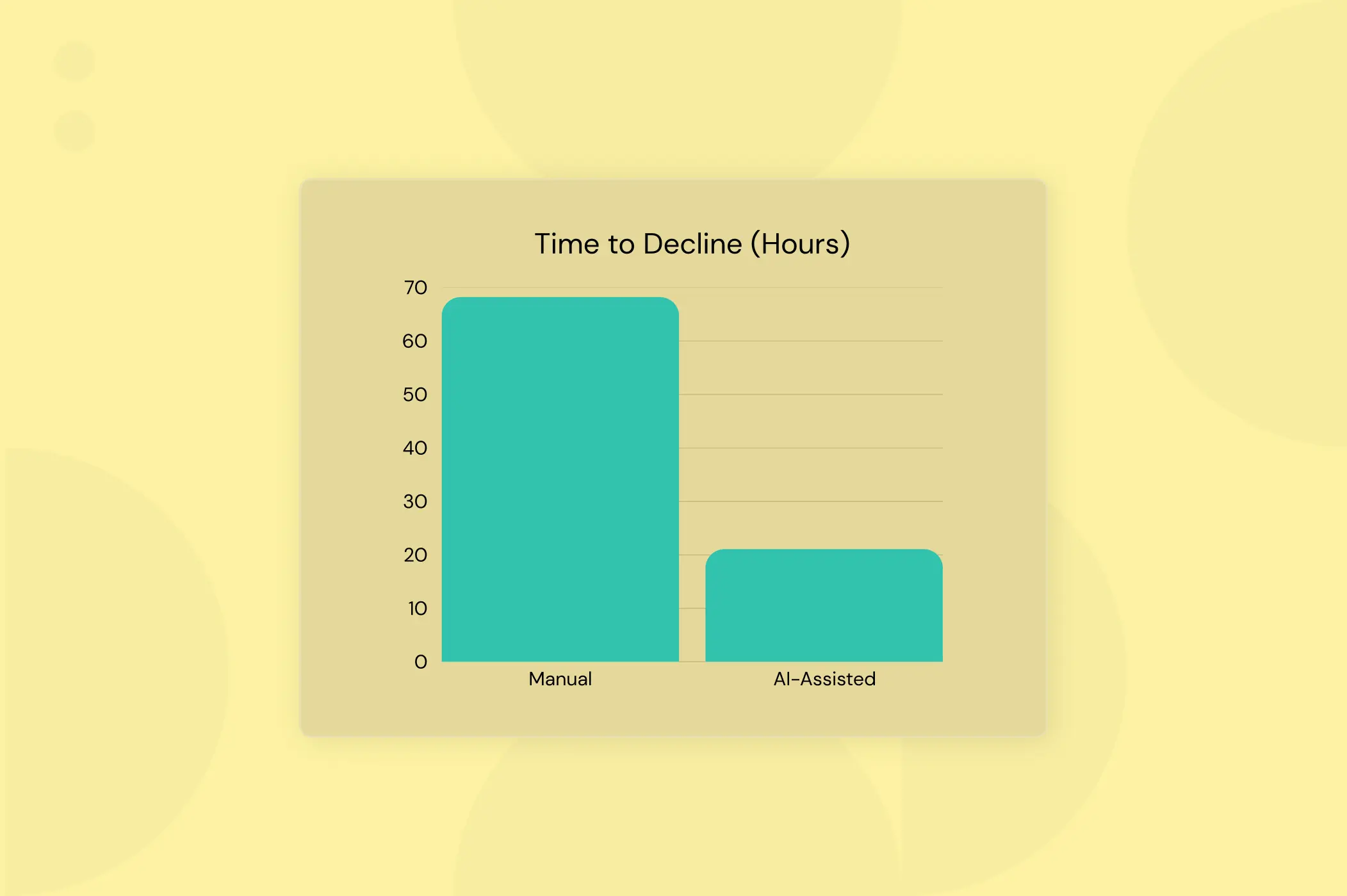
When an interviewer declines or reschedules, the system proactively engages alternatives via Slack and email. This automated chasing forces a decision, cutting the decline response time from 68 hours with manual coordination to 21 hours with autonomous agents.
Candidates receive real-time updates through a branded candidate portal that shows interview details, prep materials, interviewer bios, and next steps. Pulse feedback is collected after every interview stage, giving coordinators and talent acquisition leaders immediate visibility into candidate sentiment and interviewer performance. So, problems surface early, before they cause candidates to drop out.
Coordination teams at Level 5 shift from calendar Tetris players to strategic advisors. Consider that instead of forcing recruiting coordinators to become a master at the calendar Tetris game, they are instead spending their time analyzing data, building an employer brand, training hiring managers, and improving the hiring funnel. This means that the tactical work is handled autonomously, so the strategic work gets the attention it deserves.
The outcomes at Level 5 represent the current state-of-the-art in recruiting coordination:
- Coordinator capacity reaches one 158 interviews per week, which is five times manual capacity.
- Reschedule time drops by three times because the system forces decisions instead of waiting for humans to respond.
- Candidate satisfaction remains high even during high-volume hiring because the experience is consistent and responsive.
Companies like Relativity Space and Intercom operate at Level 5, leveraging full autonomy to handle hiring at scale without proportionally increasing headcount. Relativity Space improved scheduling speed by 76 percent in six weeks, dropping from 2.8 days to 16.2 hours per interview.
If your AI agent is chasing interviewer confirmations while your coordinator is analyzing hiring funnel data, you are at Level 5. This is where recruiting coordination becomes a competitive advantage.
Unlock the Future of Recruiting— Book a Demo Today!


What Are the Best Tools for Automating Interview Scheduling?
One of the most common questions talent acquisition teams ask is which tools can help them move from manual coordination to automated interview scheduling. The answer depends on where you are today and what capabilities you need to build next.
At Level 1 and Level 2, the priority should NOT be tools. The priority is process. Adding automation to broken processes simply automates the chaos. Before investing in scheduling technology, teams need to document their interview loops, standardize their communication, and centralize visibility. These are internal process improvements that cost time, not money.
At Level 3, teams are ready to evaluate automated interview scheduling tools. The most effective platforms offer several core capabilities. First, they provide candidate self-scheduling through a branded portal that respects interviewer availability and panel requirements. Second, they handle panel construction automatically, assigning interviewers based on expertise, seniority, training status, and availability. Third, they integrate with your ATS in real time so that scheduling updates happen automatically without manual data entry. Fourth, they include calendar intelligence that enforces interviewer preferences and prevents coordinator burnout from over-scheduling. Fifth, they use interviewer pooling to ensure that cancellations do not disrupt the candidate experience.
Platforms like candidate.fyi are built specifically for this use case. They combine self-scheduling, panel intelligence, ATS integration, and calendar management in one system designed for enterprise talent acquisition teams. Other options in the market include tools that focus on specific pieces of the coordination workflow, like calendar scheduling or feedback collection, but lack the end-to-end orchestration that Level 4 and Level 5 maturity require.
At Level 4, teams can begin to explore AI agents that handle exceptions autonomously. These agents chase interviewer confirmations, manage reschedules, and send reminders without coordinator intervention. They proactively engage interviewers via Slack and email when responses are delayed, cutting the time to resolve conflicts from days to hours. This is the capability that unlocks Level 5 maturity.
The mistake many teams make is buying tools before fixing their processes. Automation amplifies what already exists. If your interview loops are inconsistent, automation will simply make those problems faster and more visible.
Think of it like adding a turbocharger to a car with a cracked engine block. The turbo will make the car faster for a moment, but the underlying crack will spread faster under the extra pressure. Eventually, the whole engine fails, just more expensively than before. Fix the foundation first. Then add the tools that scale what works. Fix the underlying problem first.
What Are Some Common Interview Scheduling Mistakes to Avoid?
Teams that try to mature their coordination function often make predictable mistakes. These mistakes slow progress, so understanding what not to do is as important as understanding what to do.
The first mistake is buying automation before fixing the process. Teams stuck in manual chaos often think the solution is an AI agent tool. They purchase the software, turn it on, and expect coordination to improve. Instead, they automate broken processes. The tool schedules interviews faster, but it schedules the wrong people at the wrong times with no interviewer training or panel structure.
The second mistake is skipping centralized ownership. Some teams have fragmented coordination where different recruiters or hiring managers schedule their own interviews using different tools and processes. Recruiting coordinators know the “spreadsheet problem” well where each coordinator and/or hiring manager has a different Excel spreadsheet for their hiring process. The expectation is automation will unify everything. It does not. Without centralized ownership, automation creates more chaos because no one knows who is responsible and what the automation is actually doing.
The third mistake is assuming automation solves people problems. Automation cannot fix a hiring manager who never responds to interview requests or a recruiter who does not communicate expectations to candidates. If your process relies on people doing things they are not currently doing, automation will simply expose the gap faster.
The fourth mistake is underestimating the change management required to move between levels. For example, introducing self-scheduling requires recruiters and hiring managers to trust that candidates can book their own interviews without coordinator intervention. Coordinators must shift their mindset from doing the scheduling to managing the system. If teams skip the training and communication required to make these shifts, the new tools fail not because they do not work but because people do not use them correctly.
How to Optimize Your Interview Schedule: Progressing Between Maturity Levels
Moving up the maturity model requires more than new tools. It requires changes in process, ownership, and mindset. Each transition between levels has specific requirements that must be met before the next level becomes achievable.
The transition from Level 1 to Level 2 is about building foundational process discipline. Teams must document their interview loops, create standardized email templates, and establish basic coordination practices, among other initiatives. The investment required is time, not money. This is internal process work that can happen without purchasing new software.
The transition from Level 2 to Level 3 is about centralizing ownership and visibility. First, teams must assign dedicated coordinators who own scheduling end-to-end. Second, they must build a single source of truth, whether that is a centralized dashboard or a coordination tool that integrates with their calendar and email. Third, they must standardize processes across all hiring teams so that everyone follows the same workflow. The investment required is organizational alignment and potentially some technology upgrades.
The transition from Level 3 to Level 4 is about introducing automation and self-service. To start, teams must implement candidate self-scheduling through a branded portal, and they must enable AI-powered panel construction and multi-step interview loops. Next, they must ensure their new recruiting coordination platform integrates with their ATS so that updates happen automatically. The investment required is a platform like candidate.fyi and the change management to train teams on the new system.
The transition from Level 4 to Level 5 is about enabling autonomy and intelligence. Teams must activate AI agents that handle exceptions like reschedules, declines, and follow-ups without coordinator intervention. Second, they must add pulse feedback collection after each interview stage to gain real-time visibility into candidate sentiment. Third, they must shift coordinator focus from tactical execution to strategic optimization. The investment required is advanced platform features and upskilling coordinators into strategic roles.
What actually changes between levels is the mindset of the team. At Level 1, the mindset is survival. At Level 2, the mindset is consistency. At Level 3, the mindset is control. At Level 4, the mindset is efficiency. At Level 5, the mindset is optimization.
Teams that progress successfully through the maturity model treat each level as a prerequisite for the next. They do not skip steps. They do not assume that buying better tools will solve process problems. They build the capabilities required at each stage before attempting to advance.
How Interview Schedule Maturity Impacts Recruiting Coordinator Capacity and Candidate Experience
Interview schedule maturity has a direct, measurable impact on the two outcomes that matter most to talent acquisition leaders: how fast you can hire and how candidates experience the process.
The Interview Scheduling Gap Report documented the core problem that defines Level 1 and Level 2 maturity: structural rigidity meeting human behavior. At these levels, teams experience calendar Tetris, where coordinators spend 46 percent of their time on admin tasks.
The report showed that manual scheduling costs teams 243 minutes per interview, which is over four hours of delay per candidate. Teams at Level 1 and Level 2 live this reality every day.
The Recruiting Coordination Wrapped Report revealed the outcomes that teams achieve at Level 4 and Level 5. At Level 4, self-scheduling reduces time-to-schedule to 27 minutes, which is nine times faster than manual coordination. Candidate satisfaction scores 4.63 out of 5 for recruiter screens, the most automated step in the process.
The benchmark numbers in the Wrapped Report are the operational reality for teams at Level 4 and Level 5 maturity. The data proves that interview schedule optimization is about building the capabilities that allow systems to handle the work that humans used to do manually.
The progression through the maturity model unlocks capacity. At Level 1, a coordinator can handle 20-30 interviews per week. At Level 5, a coordinator can handle one 158 per week. This is not because Level 5 coordinators work longer hours. This is because 46 percent of their work is handled autonomously by AI agents, 26 percent is handled by candidates through self-service, and coordinators focus their time on the 28 percent that requires human judgment.
The progression through the maturity model also improves candidate experience. At Level 1 and Level 2, candidates wait days for scheduling confirmation. At Level 4 and Level 5, candidates book their own interviews instantly, and they receive real-time updates through a branded portal. This matters because candidate experience directly impacts whether top talent accepts your offers or ghosts your process.
How Can You Assess Your Team's Recruiting Coordination Maturity?
Understanding where your team sits on the maturity model is the first step toward intentional improvement. Most teams have an intuitive sense that something is broken, but they lack the diagnostic framework to articulate what level they are operating at and what capabilities they are missing.
The recruiting coordination maturity assessment is a twelve-question diagnostic that maps your current capabilities to the five-level framework. The questions are designed to be answered quickly with yes or no responses. They focus on observable behaviors and capabilities, not aspirations or intentions.
The assessment works on a cumulative scale. Each question represents a capability that builds on the previous ones. If you are at Level 3, you would answer yes to Level 1, Level 2, and Level 3 questions. The more yes responses you provide, the higher your maturity level.
The twelve questions cover foundational process discipline, centralized ownership and visibility, automated scheduling capabilities, and autonomous coordination features.
Once you complete the assessment, you will receive a personalized result that describes where you are today, what is broken at your current level, and what specific steps you need to take to progress to the next level. The result includes tactical guidance from our team to help you map out process changes.
The assessment takes two minutes to complete. The insights can reshape how your team approaches recruiting coordination for the next year.
Ready to find out where your team stands? Take the recruiting coordination maturity assessment here.
Interview schedule optimization is not about perfection. It is about intentional progression. If you are at Level 1, the goal is not to jump straight to Level 5. The goal is to move to Level 2 by documenting your processes and creating repeatable workflows. If you are at Level 3, the goal is to add automation strategically, starting with self-scheduling and panel intelligence, to reach Level 4.
The teams that treat coordination as a strategic capability rather than an administrative burden are the ones that win in competitive talent markets. They schedule faster. They deliver better candidate experiences. They scale hiring without proportionally increasing headcount. The question is not whether your team should mature its coordination function. The question is which level you are at today and what you will do next to move forward.